
“Different - A Great Thing to Be” Rhyming Lesson
Students will identify personal similarities and differences between peers. Students will listen to read/listen to “Different… A Great Thing to Be” and identify rhyming words. After the lesson, students will write a poem about being different.
Image Description: cover of the book "Different: A Great Thing to Be!" includes an illustration of a girl with long brown hair holding flowers. Her eyes are closed and she's wearing glasses.

Disability Data Art
In this lesson, students will learn about data art, an art form that takes scientific or mathematical data and translates it into a visual art form such as a painting, drawing or sculpture. Using disability related statistical data from provided sources, they will create their own piece of data art. The students will also write short reflections on the artwork that they create. This lesson can function both as a standalone art exercise, or may be a useful closing exercise for a unit in math or science that focuses on statistics.
Image Description: Text at top of image in white says “Disability Data Art”. Image with a water like teal and pale yellow background and assorted shapes in various colors from the previous chart overlaid on the background.

Disability and Disability Arts - Physical Disability and Accessibility- Coloring Book - “A Day of Questions”
Disability and Disability Arts - Physical Disability and Accessibility- Coloring Book - “A Day of Questions”
This is a three part lesson to introduce the student to disability and a disabled artist's work. Disability arts is an art form where the context of the art takes on disability as its theme. Disability art is about exploring the various realities of what it's like to be disabled. The theme of disability may be used in a variety of ways in how the artist chooses to represent the theme in their work. This lesson uses a coloring book created by Wendy Elliot Vandivier.
Image Description: Cover artwork for the book “A Day of Questions” by Wendy Elliot-Vandivier. The background is yellow and has a drawing of a woman in a read dress with shoulder length red hair sitting in a motorized wheelchair with a service dog wearing a red vest in front of her with a question mark over the dogs head. There are 6 illustrations of children on each side of the cover facing the center with question marks in the background.
Disability and Disability Arts Invisible Disabilities/Autism/Poetry/Golden Shovels Poetic Form
Lesson title: Disability and Disability Arts - Disability and Disability Arts Invisible Disabilities/ Autism/Poetry/ Golden Shovels Poetic Form
This is a three part lesson to introduce the student to disability and a disabled artist's work. Disability arts is an art form where the context of the art takes on disability as its theme. Disability art is about exploring the various realities of what it's like to be disabled. The theme of disability may be used in a variety of ways in how the artist chooses to represent the theme in their work. This lesson uses poetry created by Ian Fay.
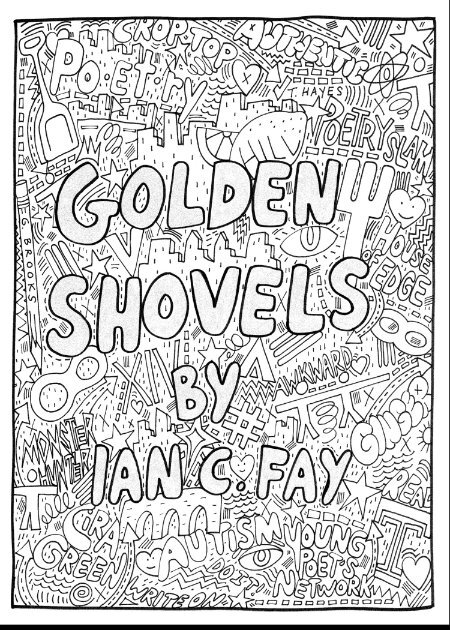
Image Description: black and white illustration with the title “Golden Shovels by Ian C. Fay” in bold open letters. The background is filled with dense, intricate doodle pattern.

Disability and Disability Arts - Invisible Disabilities - “See Me; Invisibility” Paintings Lessons
Disability and Disability Arts - Invisible Disabilities - “See Me; Invisibility” Paintings Lessons
This is a three part lesson to introduce the student to disability and a disabled artist's work. Disability arts is an art form where the context of the art takes on disability as its theme. Disability art is about exploring the various realities of what it's like to be disabled. The theme of disability may be used in a variety of ways in how the artist chooses to represent the theme in their work. This lesson uses 3 paintings created by Mali Fenning.
Image Description: 3 paintings by Mali Fenning. Left artwork features geometric shapes and a dark color palette. Top right art features a colorful face with red lips and curly hair. The bottom right artwork has wavy lines and circular shapes in a mix of colors.

Disability and Disability Arts Vision Loss - Disability Empowerment “Disability Looks Like You and Me”
Disability and Disability Arts Vision Loss - Disability Empowerment “Disability Looks Like You and Me”
This is a three part lesson to introduce the student to disability and a disabled artist's work. Disability arts is an art form where the context of the art takes on disability as its theme. Disability art is about exploring the various realities of what it's like to be disabled. The theme of disability may be used in a variety of ways in how the artist chooses to represent the theme in their work. This lesson uses art created by Jade Ramos.
Image description: A colorful abstract artwork featuring a silhouette of a person with long hair outlined in bright neon colors. The background is filled with vibrant, swirling patterns. Text says “Every One Matters, Even You” along the left and right edges. The person is wearing a shirt with the text “Disability Looks Like You and Me”

Disability History through Primary Sources
As our friends from Engaging America state, “Primary sources … can provide entry points and deepen exploration into historical events. Primary sources add immediacy, such as the faces in a photograph, the emotional tone of a drawing or song, or the complex look of a handwritten document. Documents from multiple points of view can illuminate conflicting ideas and events. Varied media, including maps, oral histories, published reports, and graphs offer many options for connection and investigation”.
We share these collections or primary sources as tools to continue introducing disability into the conversation from natural perspectives, using disabled people to tell their own stories whenever possible.
Image Description: Article from Dallas Times Herald, Wednesday, January 14, 1986 in section “Community Close-Up” titled “Police on sidewalk wheelchair ramps changed”
Full image description can be found at: https://adaptmuseum.net/gallery/picture.php?/451/category/16

Disability History Timeline Lesson
This lesson is meant to accompany Disability Equality in Education’s Disability History Timeline. Printable images are included in the materials to use with this lesson. In this lesson, students will select a moment from disability history and analyze its importance.
Image description: tiles from DEE”s Disability History Timeline on the wall

Disability Justice Lesson Plan - Education Amplifier
In this lesson plan, you’ll find six modules that you can mix and match, that all teach about different aspects of disability rights and disability justice.
Image Description: Education Amplifier’s illustration of Lydia X.Z. Brown
Disability Informed Reading Guides
Disability Informed Reading Guides
Image Description: “Disability Informed Reading Guides” pale yellow and blue background with black text. Simple black book with white pages graphic.
Disability Rights Lesson by BrainPOP
This BrainPop video and associated resources introduce the Disability Rights movement through the fight for Section 504, the law that paved the way for the Americans with Disabilities Act.
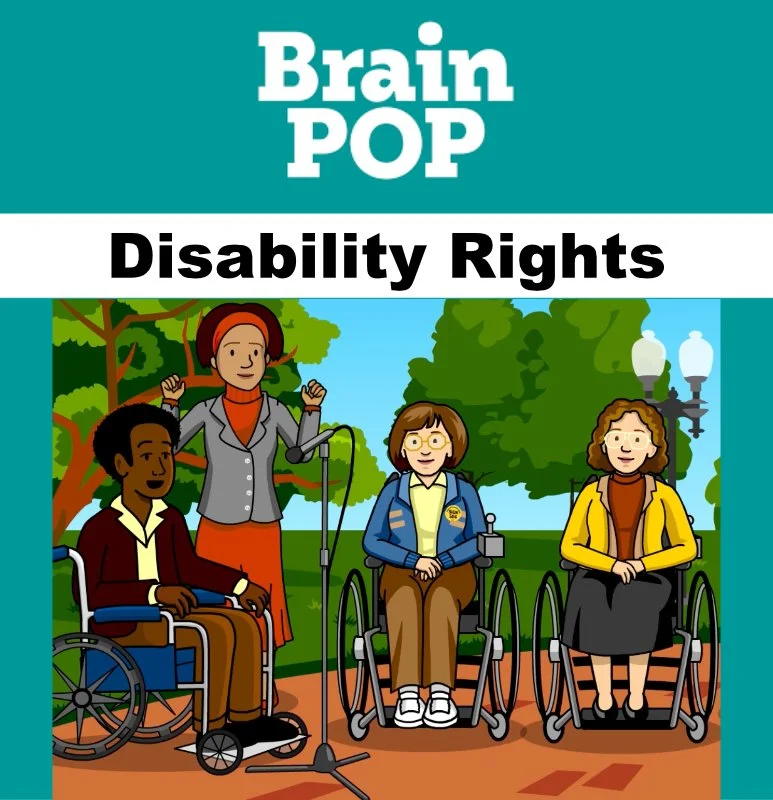
Image Description: BrainPOP logo, “Disability Rights” and animated screenshot from the video showing 4 people outdoors, 3 are seated in wheelchairs, one is standing in front of a microphone.

Disability Rights as Human Rights: The Role of the Convention on the Rights of Persons with Disabilities (CRPD)
Through reading selections of the United Nations Convention on the Rights of Persons with Disabilities (CRPD), students will explore the role of international agreements in shaping national policies. They will engage with key human rights vocabulary, analyze how the CRPD has influenced disability rights worldwide, and explore issues pertaining to US non-ratification. This lesson encourages critical thinking about disability as a civic and human rights issue, emphasizing the responsibilities of governments in upholding equality and justice. Differentiation strategies for middle vs high school students would include using the original vs easy-read version of the text, as well as differentiated discussion questions.
Image Description: Left, United Nations emblem consisting of a world map surrounded by two olive branches, all in white on a blue background. Right, CRPD logo, each letter on its own in white on a maroon square arranged in a 2×2 grid. To the right are the words “Convention on the Rights of Persons with Disabilities” in maroon.
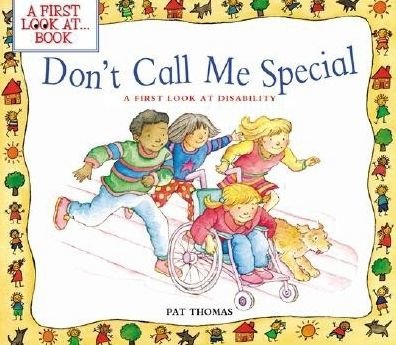
Don’t Call Me Special: Reading and Discussion
This is an introductory lesson on physical disability using the book “Don’t Call Me Special” by Pat Thomas. The educator will read aloud the book and ask questions about the text. Students will learn about making assumptions and what physical disability can look like, as well as how equipment can help students with disabilities access all parts of their life.
Image description: cover art for the book “Don’t Call Me Special”

Dots: An Introduction to Braille Lowercase Letters
This is a fun way to introduce the braille alphabet in English (Grade 1 braille) to young learners. Sighted and blind learners will use an exploration of braille to reinforce their knowledge of lowercase letters. This activity can also give students, sighted and blind, a fun way to explore sight words.
Image description: Hand moving over a text in braille

Drawing your City - the Art of Stephen Wiltshire
In this lesson, students will be exposed to the artwork of Stephen Wiltshire. Wiltshire is from Britain and known for his large-scale detailed drawings of cityscapes. After learning about Wiltshire, who is autistic, students will have the opportunity to draw their own cityscape, inspired by Wiltshire’s art. For an extra geographic element, they can write facts about their city and create a bulletin board display. They will also consider how Wiltshire is often most widely described as a savant/genius, and how these words can create challenging stereotypes, both for the autistic community and for artists. For both, these words set up unrealistic expectations about who autistic people are/can be, and what art is/can be/how much training and practice is required to be an artist.
Image Description: Photo from behind a person wearing a dark jacket and a cap with headphones that is drawing on a large, detailed cityscape illustration. The drawing appears to be a bird's-eye view of a city with numerous buildings and streets.

Easterseals Short Films Lesson Plan
Students will review the social model of disability and then apply it to 4 short films created for the Easterseals Disability Film Challenge. “The Easterseals Disability Film Challenge gives filmmakers—with and without disabilities—the opportunity to collaborate to tell unique stories that showcase disability in its many forms (disabilityfilmchallenge.com).” Students will watch the 4 winning films, and then break into groups to focus on analyzing one film as a group.

Emerging America - The Long Struggle for Disability Rights
Summary:
An introduction helps establish safe and respectful study of disability history. In lesson 1, students the Question Formulation Technique helps develop questions. Then a presentation highlights disabled advocates across American history. In lesson 2, students research the causes, goals and methods, successes and setbacks of the Disability Rights Movement. Students present research with multiple media options: talk with slides, podcast, video, essay, or poster. Lesson 4 guides a genuinely inclusive civic engagement project.
Image Description: Emerging America logo above text that reads “Grades 9-12: The Long Struggle for Disability Rights” above a black and white photo of ADAPT protesters seated on the ground and in wheelchairs holding signs c. 1980s

Emerging America - Disability in the Progressive Era
Summary:
An introduction to disability helps establish safe and respectful study of a difficult topic. Students examine eugenics policy, including forced sterilization and examine how values change. Primary sources include challenges to eugenics from the 1930s as well as 21st century efforts to come to terms with its impacts. The grades 4-5 lesson 2 on immigration policy can provides primary sources and guiding questions that can provide solid support to expand this unit. Unit resources support optional research projects.
The material is emotionally difficult. It is essential to create a safe space for all, including students who might relate personally to the topic. Particular attention is required to ensure that discussion respects students of varied views. It is vital to clarify that universal norms of democracy today are clear that there is no valid justification for the program of eugenics and that its claims were in no way supported by valid science.
Image Description: Emerging America logo above text that reads “Grades 9-12: Disability in the Progressive Era” above a black and white photo of William H. Taft, Oliver Wendell Holmes, Jr. and others in front of the White House. c.1922

Emerging America - How Civil War Veterans Transformed Disability
Summary:
All the grades 8-10 units begin with a brief introduction to the topic. Lessons 1 & 2 could anchor study of the Second Great Awakening and other reforms of the period or integrate within a larger unit. Lesson 2 introduces some of the problems with larger-scale institutionalization and thus could provide a foundation for further study of the exposés and struggles for independent living throughout the 20th century.
Image Description: Emerging America logo above text that reads “Grades 8-10: How Civil War Veterans Transformed Disability” above a black and white photo of the Wounded from the Battle of the Wilderness c. 1864

Emerging America - Founding of Schools and Asylums
Summary:
All the grades 8-10 units begin with a brief introduction to the topic. Lessons 1 & 2 could anchor study of the Second Great Awakening and other reforms of the period or integrate within a larger unit. Lesson 2 introduces some of the problems with larger-scale institutionalization and thus could provide a foundation for further study of the exposés and struggles for independent living throughout the 20th century.
Image Description: Emerging America logo above text that reads “Grades 8-10: Founding of Schools and Asylums” above a sepia-toned lithograph of the American School for the Deaf c. 1881