
The Americans with Disabilities Act: Taking Action for Access Lesson by National History Day
By analyzing various primary and secondary sources, students will determine how citizen activism among the disabled community led to passage of the Americans with Disabilities Act (ADA) in 1990. After reviewing ADA provisions that improved access to public facilities and the workplace, students will identify continued areas of need for people with disabilities and develop public service announcements that promote personal responsibility for maintaining accessibility.
Image Description: National History Day logo, “The Americans with Disabilities Act: Taking Action for Access,” and a series of 4 blue and white accessibility symbols arranged in a diamond pattern with “Americans with Disabilities Act” along the top edges.

Americans with Disabilities Act Lesson by C-SPAN
This lesson details the provisions of the Americans with Disabilities Act signed by President George H.W. Bush. It also looks at the 20th Anniversary speech made by President Barack Obama and his vision for the future of Americans with Disabilities.
Image Description: C-SPAN Classroom logo, “Americans with Disabilities Act” and photo of the signing of the ADA

Calculating the Distance Lesson by Rick Hansen Foundation
In this lesson, students complete grade-appropriate math problems using facts and figures from Rick Hansen’s Man In Motion World Tour. Students will examine mathematical problems evolving out of the day-to-day challenges of Rick Hansen’s Man In Motion World Tour. Students will apply multiplication and division skills to real-life math problems. Students will apply conversion skills to real-life math problems.
Image Description: Logo of Rick Hansen Foundation.

Common Lit - Analyzing the Author's Point of View with "I'm a Disabled Teenager, and Social Media Is My Lifeline" Lesson
In this opinion piece, students will learn about one teenager’s perspective on the value of social media, especially for people with disabilities. Students will analyze the author’s point of view about social media.
Image Description: Logo of CommonLit which looks like an open book with a colorful image of assorted figures with a black silhouette of a person in front

Common Lit - Analyzing Text Structures with "Everyone Can Play" Lesson
In this text, students will learn about how video games are being adapted to meet the needs of players with disabilities. Students will practice analyzing text structures. They will understand how paragraphs build on one another and how authors organize their writing using specific text structures such as subheadings.
Image Description: Logo of CommonLit, which looks like an open book at the top, with an image of a student and 3 computer screens against a blue curtain
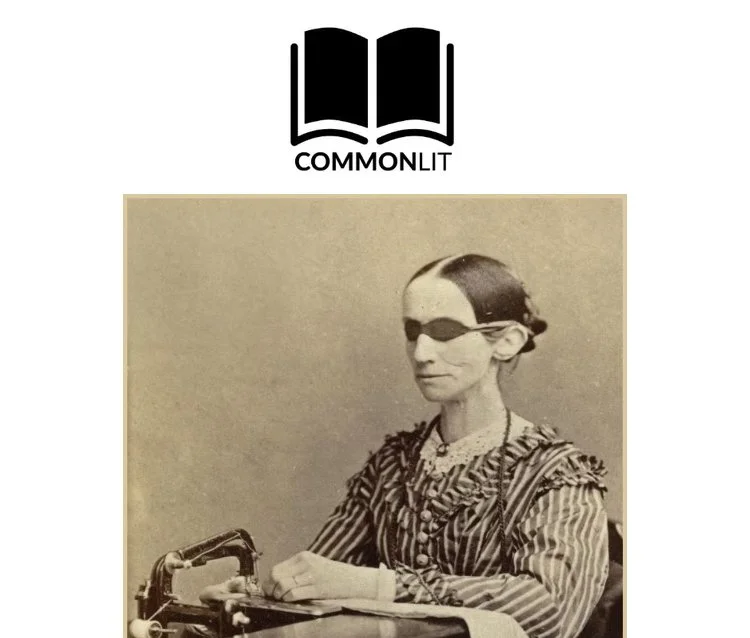
CommonLit - The Girl Who Listened with Her Feet
Students read an informational text about Laura Bridgman, the first deaf-blind person to learn to read and write a language, and explore how she developed her own ways of communicating and learning before and after attending the Perkins Institution. Through reading and discussion, students consider how access to education shapes what people are able to do, and what assumptions about disability can get in the way of that access.
Image Description: Logo of CommonLit, which looks like an open book with a sepia tone photo of Laura Bridgman at a sewing machine
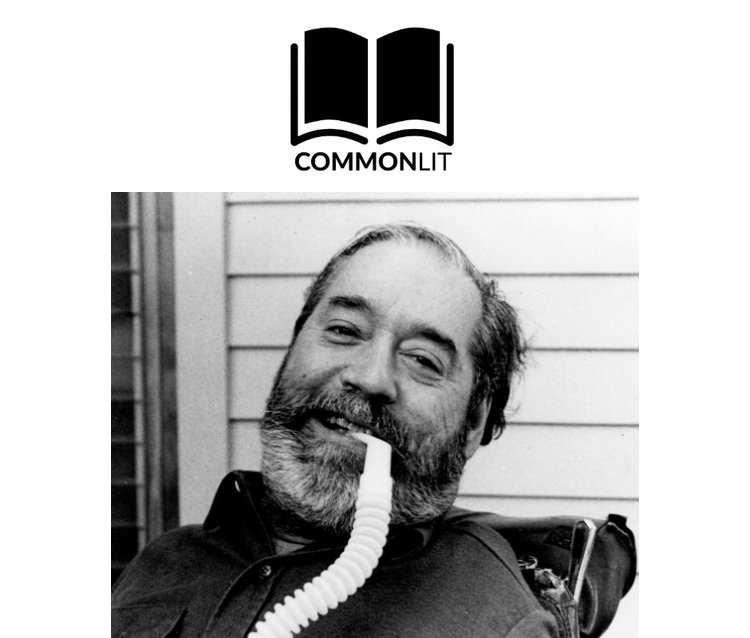
CommonLit - On Disability Rights: Highlights from Speeches by Ed Roberts
Students read a compilation of speeches by Ed Roberts, a disability rights activist and organizer, and examine how he uses personal narrative, humor, and argument to make the case for disabled people's autonomy, access, and civil rights. Through reading and discussion, students analyze Roberts' rhetorical choices and consider how individuals and communities build power to challenge systemic barriers.
Image Description: Logo of CommonLit, which looks like an open book with a photo of Ed Roberts with his breathing tube in his mouth
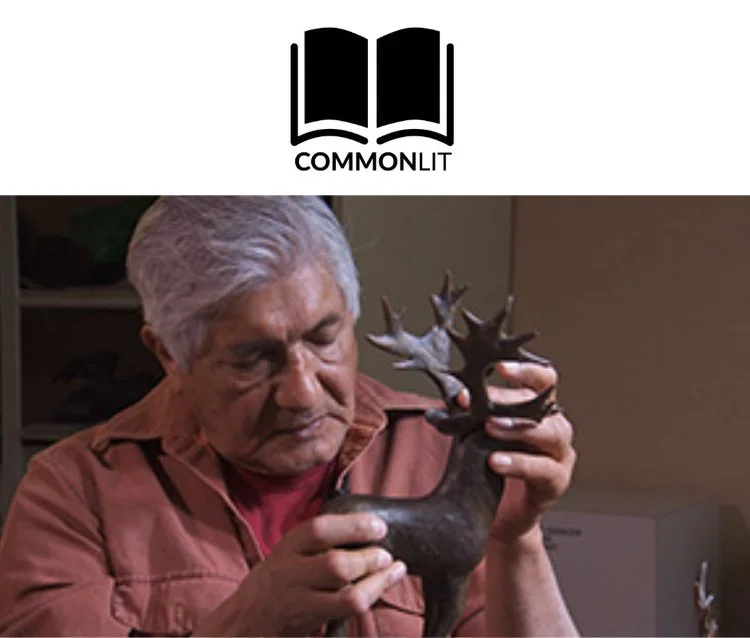
Common Lit - A Touch of Genius
Students read a biographical profile of Michael Naranjo, a Tewa sculptor who is blind, and explore how his artistic practice is rooted in memory, touch, and a lifelong connection to his community and culture. Through reading and discussion, students consider what it means to express yourself through art and how Naranjo's work connects to his identity as a Native American artist and Vietnam veteran
Image Description: Logo of CommonLit, which looks like an open book with a photo of Michael Naranjo holding a sculpture of a horned animal in his hands
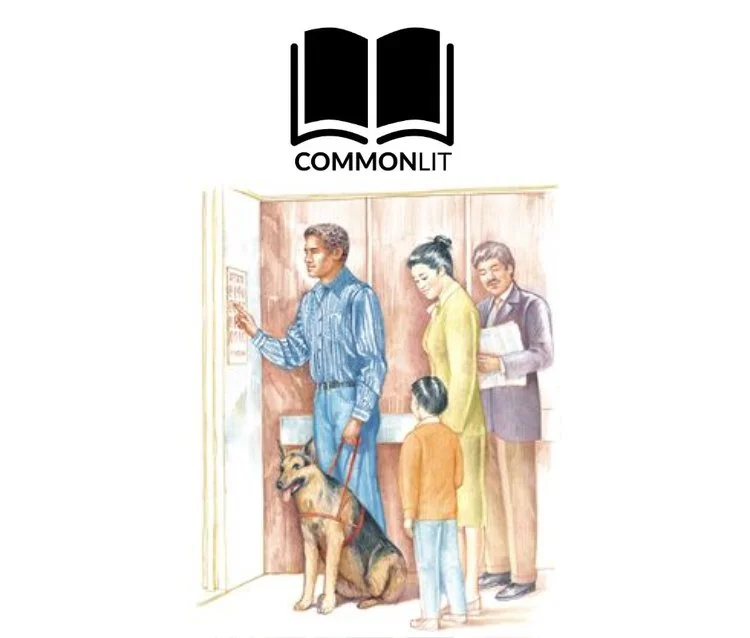
Common Lit - Louis Braille Lesson
Students read a short biographical text about Louis Braille and explore how he developed a tactile reading and writing system that became a tool for access used around the world. Through reading and discussion, students consider how barriers to literacy shaped Braille's innovations and how those innovations continue to open doors for blind and low-vision communities today.
Image Description: Logo of CommonLit, which looks like an open book with a drawing of a person with his guide dog and 3 other people in an elevator

Common Lit - Identifying Main Ideas and Central Idea with“College students with disabilities are too often excluded”
In this text, students learn about the experiences of people with disabilities in college and the actions that can be taken to create more inclusive campuses. Students practice finding the main ideas of each paragraph or section and then the article’s overall central idea.
Image Description: Logo of CommonLit which looks like an open book on top with a photo of a student seated in a wheelchair in a large stadium seating classroom

Crip Camp Curriculum
In this collection of lesson plan, students will learn about media literacy and apply those skills to the media created for the film CRIP CAMP; will explore the concepts of power and justice, and how they relate to disability rights and disability justice; will explore the concepts of power, civil rights, and human rights, and how these concepts relate to disability rights, and then apply those skills to the media created for the film CRIP CAMP; will understand how language is connected to power and ableism; and discuss how the strategic use of power helped the disability rights movement in the US evolve.
Image Description: “Crip Camp Curriculum” in white text on green background

Deaf President Now Unit
This unit focuses on the historical event that caused a ripple in the Deaf community, Deaf President Now. The unit includes three lessons, three projects, and a lot of fun!
Image Description: Black and white photo of students holding a banner that says “Deaf Prez Now!”.

The Day the World Heard ... Kent State and Gallaudet University
Students will be introduced to two important events in US history – the Kent State Massacre and Deaf President Now protest. They will be exposed to the events that occurred on the two college campuses and their outcomes. They will read the First Amendment and be presented with information to assist them in drawing conclusions about whether these were peaceful protests. They will obtain information to assist them in comparing and contrasting the two events. As the culminating activity, students will create a storyboard about May 4, 1970 at Kent State.
* NOTE: This lesson could be taught during Deaf Awareness week and the following week ‐‐ could encompass ASL, history and ELA classes.
Image Description: Colorful painting depicting a protest scene in front of a domed building. In the foreground, several figures are holding a large sign that reads "DEAF PRESIDENT NOW" in red letters. There are also several flags in vibrant colors, including red, blue, and yellow, being waved by the crowd.

Disability History through Primary Sources
As our friends from Engaging America state, “Primary sources … can provide entry points and deepen exploration into historical events. Primary sources add immediacy, such as the faces in a photograph, the emotional tone of a drawing or song, or the complex look of a handwritten document. Documents from multiple points of view can illuminate conflicting ideas and events. Varied media, including maps, oral histories, published reports, and graphs offer many options for connection and investigation”.
We share these collections or primary sources as tools to continue introducing disability into the conversation from natural perspectives, using disabled people to tell their own stories whenever possible.
Image Description: Article from Dallas Times Herald, Wednesday, January 14, 1986 in section “Community Close-Up” titled “Police on sidewalk wheelchair ramps changed”
Full image description can be found at: https://adaptmuseum.net/gallery/picture.php?/451/category/16

Disability Justice Lesson Plan - Education Amplifier
In this lesson plan, you’ll find six modules that you can mix and match, that all teach about different aspects of disability rights and disability justice.
Image Description: Education Amplifier’s illustration of Lydia X.Z. Brown
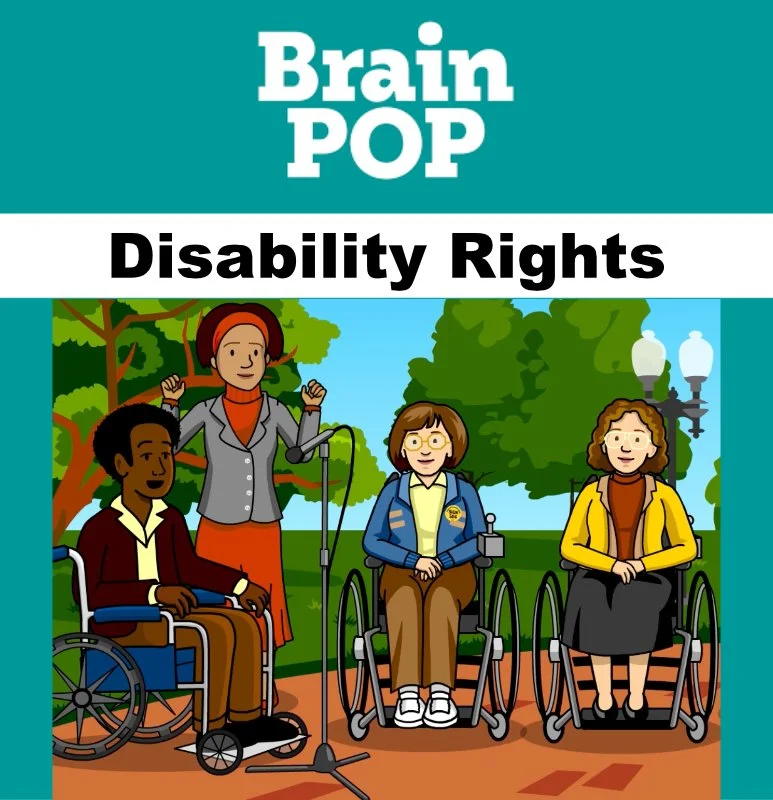
Disability Rights Lesson by BrainPOP
This BrainPop video and associated resources introduce the Disability Rights movement through the fight for Section 504, the law that paved the way for the Americans with Disabilities Act.
Image Description: BrainPOP logo, “Disability Rights” and animated screenshot from the video showing 4 people outdoors, 3 are seated in wheelchairs, one is standing in front of a microphone.

Emerging America - The Long Struggle for Disability Rights
Summary:
An introduction helps establish safe and respectful study of disability history. In lesson 1, students the Question Formulation Technique helps develop questions. Then a presentation highlights disabled advocates across American history. In lesson 2, students research the causes, goals and methods, successes and setbacks of the Disability Rights Movement. Students present research with multiple media options: talk with slides, podcast, video, essay, or poster. Lesson 4 guides a genuinely inclusive civic engagement project.
Image Description: Emerging America logo above text that reads “Grades 9-12: The Long Struggle for Disability Rights” above a black and white photo of ADAPT protesters seated on the ground and in wheelchairs holding signs c. 1980s

Emerging America - Disability in the Progressive Era
Summary:
An introduction to disability helps establish safe and respectful study of a difficult topic. Students examine eugenics policy, including forced sterilization and examine how values change. Primary sources include challenges to eugenics from the 1930s as well as 21st century efforts to come to terms with its impacts. The grades 4-5 lesson 2 on immigration policy can provides primary sources and guiding questions that can provide solid support to expand this unit. Unit resources support optional research projects.
The material is emotionally difficult. It is essential to create a safe space for all, including students who might relate personally to the topic. Particular attention is required to ensure that discussion respects students of varied views. It is vital to clarify that universal norms of democracy today are clear that there is no valid justification for the program of eugenics and that its claims were in no way supported by valid science.
Image Description: Emerging America logo above text that reads “Grades 9-12: Disability in the Progressive Era” above a black and white photo of William H. Taft, Oliver Wendell Holmes, Jr. and others in front of the White House. c.1922

Emerging America - How Civil War Veterans Transformed Disability
Summary:
All the grades 8-10 units begin with a brief introduction to the topic. Lessons 1 & 2 could anchor study of the Second Great Awakening and other reforms of the period or integrate within a larger unit. Lesson 2 introduces some of the problems with larger-scale institutionalization and thus could provide a foundation for further study of the exposés and struggles for independent living throughout the 20th century.
Image Description: Emerging America logo above text that reads “Grades 8-10: How Civil War Veterans Transformed Disability” above a black and white photo of the Wounded from the Battle of the Wilderness c. 1864

Emerging America - Founding of Schools and Asylums
Summary:
All the grades 8-10 units begin with a brief introduction to the topic. Lessons 1 & 2 could anchor study of the Second Great Awakening and other reforms of the period or integrate within a larger unit. Lesson 2 introduces some of the problems with larger-scale institutionalization and thus could provide a foundation for further study of the exposés and struggles for independent living throughout the 20th century.
Image Description: Emerging America logo above text that reads “Grades 8-10: Founding of Schools and Asylums” above a sepia-toned lithograph of the American School for the Deaf c. 1881