Coloring Books, Pages and Clip Art with Disability Representation
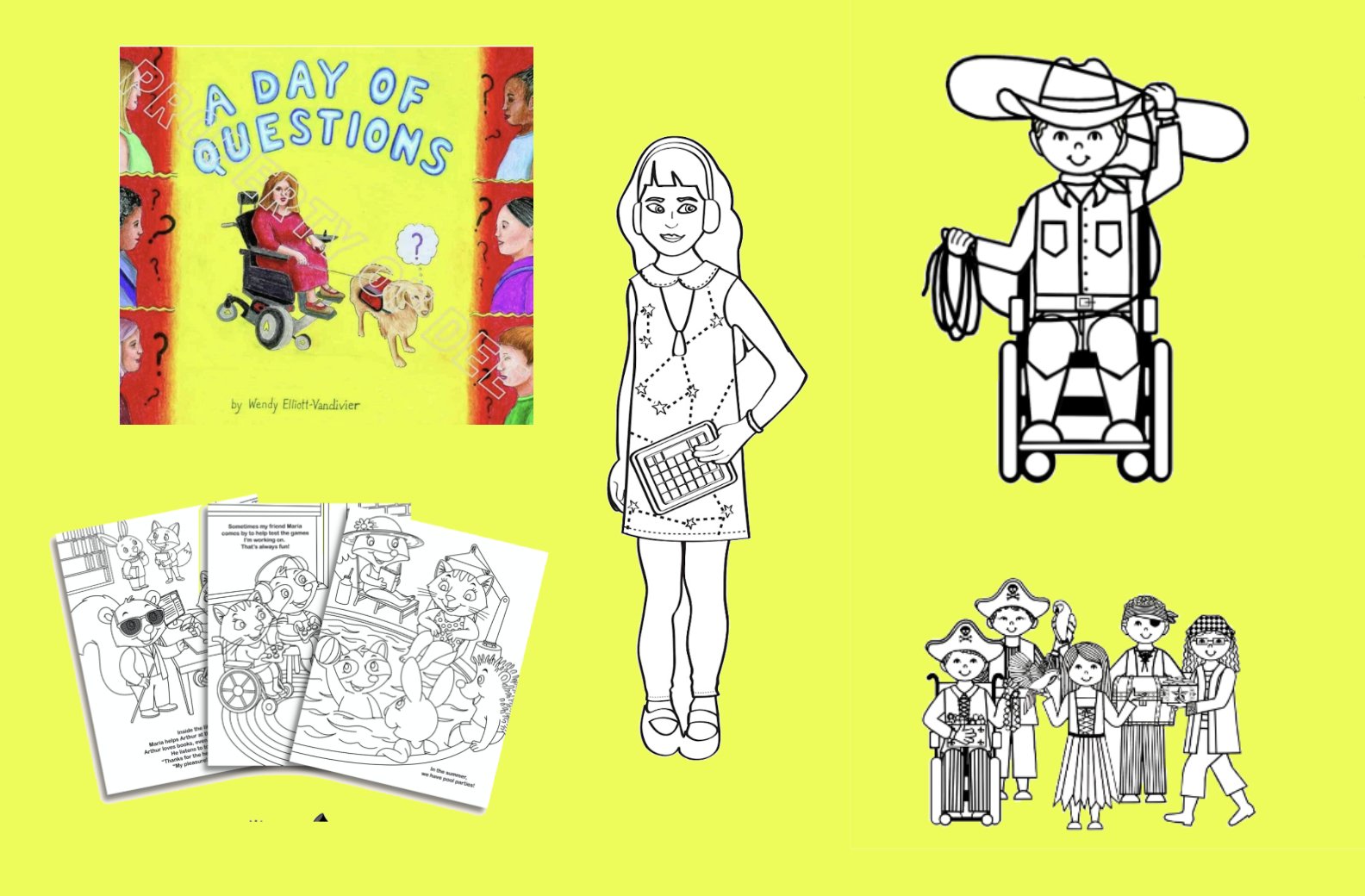
Including coloring pages and artwork in lessons (some of these allow you to use as clip art) that includes disability representation furthers the goal of regularizing disability by seeing it and offering opportunities to learn and ask questions.
Image Description: small images of the coloring books on a yellow background

Come Over to My House Lesson
Students will participate in an interactive read-aloud and discussion of the picture book “Come Over to My House” by Eliza Hull and Sally Rippin, exploring its representation of disabilities. They will respond to a writing prompt inspired by the book and create artwork to accompany their writing. The lesson concludes with reflective questions and optional follow-up activities to address student inquiries.
Image Description: Cover of a children's book titled "Come Over to My House." It features a group of children and a dog and 2 adults at an open door. One child is in a wheelchair, another is upside down, and there is a dog sitting in the middle. The children are smiling and appear welcoming.

Common Lit - Analyzing the Author's Point of View with "I'm a Disabled Teenager, and Social Media Is My Lifeline" Lesson
In this opinion piece, students will learn about one teenager’s perspective on the value of social media, especially for people with disabilities. Students will analyze the author’s point of view about social media.
Image Description: Logo of CommonLit which looks like an open book with a colorful image of assorted figures with a black silhouette of a person in front

Common Lit - Analyzing Text Structures with "Everyone Can Play" Lesson
In this text, students will learn about how video games are being adapted to meet the needs of players with disabilities. Students will practice analyzing text structures. They will understand how paragraphs build on one another and how authors organize their writing using specific text structures such as subheadings.
Image Description: Logo of CommonLit, which looks like an open book at the top, with an image of a student and 3 computer screens against a blue curtain
CommonLit - The Girl Who Listened with Her Feet
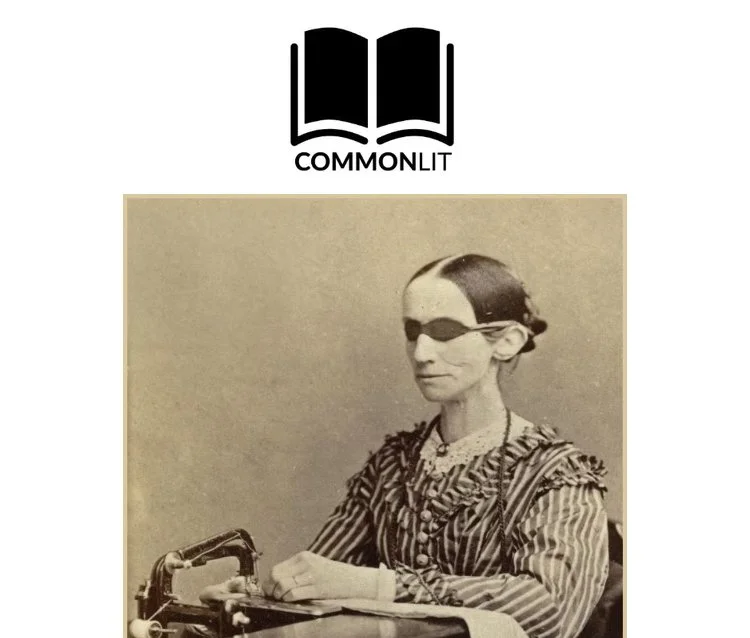
Students read an informational text about Laura Bridgman, the first deaf-blind person to learn to read and write a language, and explore how she developed her own ways of communicating and learning before and after attending the Perkins Institution. Through reading and discussion, students consider how access to education shapes what people are able to do, and what assumptions about disability can get in the way of that access.
Image Description: Logo of CommonLit, which looks like an open book with a sepia tone photo of Laura Bridgman at a sewing machine
CommonLit - On Disability Rights: Highlights from Speeches by Ed Roberts
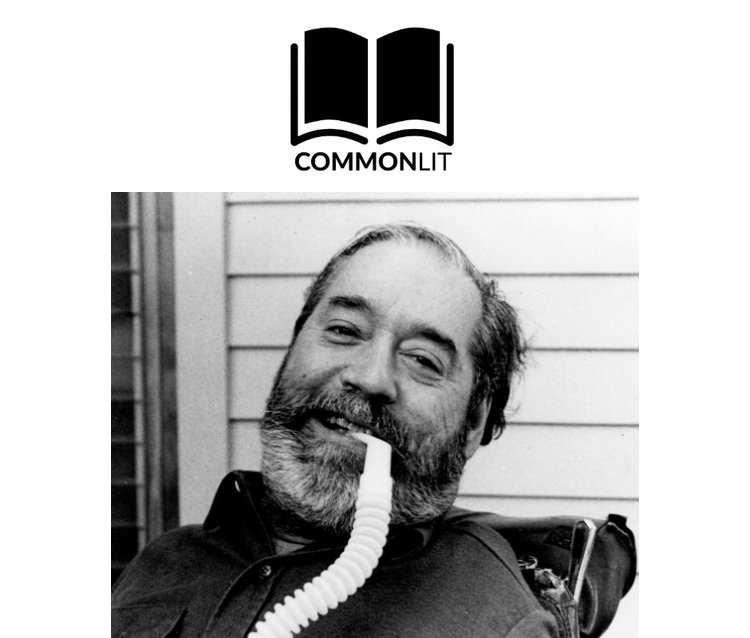
Students read a compilation of speeches by Ed Roberts, a disability rights activist and organizer, and examine how he uses personal narrative, humor, and argument to make the case for disabled people's autonomy, access, and civil rights. Through reading and discussion, students analyze Roberts' rhetorical choices and consider how individuals and communities build power to challenge systemic barriers.
Image Description: Logo of CommonLit, which looks like an open book with a photo of Ed Roberts with his breathing tube in his mouth
Common Lit - A Touch of Genius
Students read a biographical profile of Michael Naranjo, a Tewa sculptor who is blind, and explore how his artistic practice is rooted in memory, touch, and a lifelong connection to his community and culture. Through reading and discussion, students consider what it means to express yourself through art and how Naranjo's work connects to his identity as a Native American artist and Vietnam veteran
Image Description: Logo of CommonLit, which looks like an open book with a photo of Michael Naranjo holding a sculpture of a horned animal in his hands
Common Lit - Louis Braille Lesson
Students read a short biographical text about Louis Braille and explore how he developed a tactile reading and writing system that became a tool for access used around the world. Through reading and discussion, students consider how barriers to literacy shaped Braille's innovations and how those innovations continue to open doors for blind and low-vision communities today.
Image Description: Logo of CommonLit, which looks like an open book with a drawing of a person with his guide dog and 3 other people in an elevator

Common Lit - Identifying Main Ideas and Central Idea with“College students with disabilities are too often excluded”
In this text, students learn about the experiences of people with disabilities in college and the actions that can be taken to create more inclusive campuses. Students practice finding the main ideas of each paragraph or section and then the article’s overall central idea.
Image Description: Logo of CommonLit which looks like an open book on top with a photo of a student seated in a wheelchair in a large stadium seating classroom

Concentric Circles Lesson
In this lesson students will contemplate how they perceive disability and explore stereotypes and misconceptions of disability through a circle discussion activity. This lesson is intended as an introductory activity on disability. Students are just beginning the discussion on disability.
Image description: rainbow concentric circles

Creative Problem Solving with Joshua Miele and Krishna Washburn
Students will explore problem-solving by learning how scientist Joshua Miele and ballerina Krishna Washburn overcame challenges. They will then create their own invention - either practical or imaginative - through drawing, writing, or crafting a model. Afterward, they will be paired with a student interviewer who will either conduct a class interview or write a news article about their invention.
Image Description: “Creative Problem Solving with Joshua Miele and Krishna Washburn” in black text on a medium to light blue rectangle. The background of the image is a few dozen black question marks in various fonts, sizes and angles
Crip Camp Curriculum
In this collection of lesson plan, students will learn about media literacy and apply those skills to the media created for the film CRIP CAMP; will explore the concepts of power and justice, and how they relate to disability rights and disability justice; will explore the concepts of power, civil rights, and human rights, and how these concepts relate to disability rights, and then apply those skills to the media created for the film CRIP CAMP; will understand how language is connected to power and ableism; and discuss how the strategic use of power helped the disability rights movement in the US evolve.
Image Description: “Crip Camp Curriculum” in white text on green background

Critical Media Analysis: Autistic characters in children’s media
Summary:
In this lesson, students will look at four different characterizations of autistic children in contemporary media. They will watch excerpts or videos featuring the characters, read about the characters, and study how they were created. They will then fill out an evaluation chart to analyze the different depictions. They will have a group discussion as a class and write a reflective response.
Issues considered will include: character’s role within the show/movie; who was involved in writing/creating the characters; what public response has been; and so on. The lesson will conclude with a group discussion and students will complete a journal-style piece of writing as an exit ticket.
The characters that the students will learn about are:
Julia from the television show Sesame Street;
Pablo from the television show Pablo;
the main character from a Pixar short called Loop;
Carl, from the show Carl the Collector.
Image Description: Upper left quadrant is Julia, a muppet with yellow skin and orange hair. Upper right quadrant shows the main character from Loop, a girl with brown skin and dark hair who is reaching with her hands to touch reeds. Bottom left quadrant shows Pablo, a hand-drawn boy with light skin standing on a green hill with a rainbow behind him. Bottom right quadrant shows Carl, an illustrated raccoon wearing an argyle sweater.
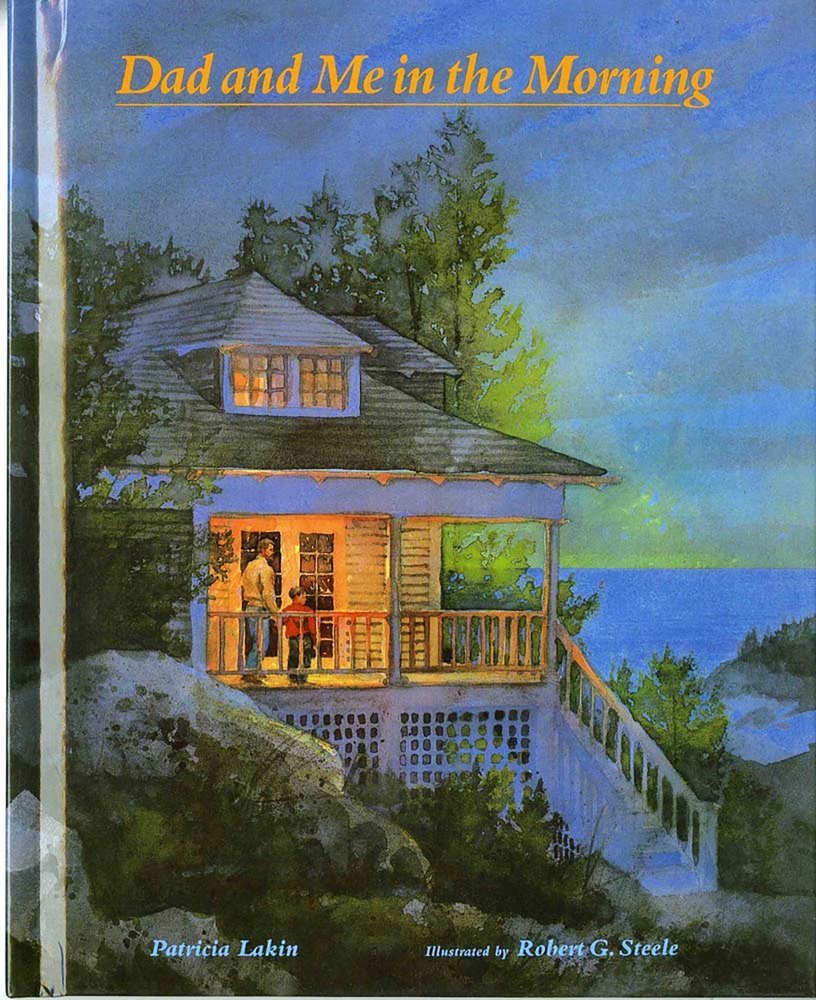
Dad and Me in the Morning Guided Reading Lesson
This lesson revolves around the book Dad and Me in the Morning by Patricia Lakin. The book tells the short story of a boy and his dad getting up early to see the sunrise. The book is unique because the boy in the story is deaf and the book shows the different ways he and his dad communicate. It is a great example of how the disabled perspective can be brought to a story that most children can relate with. In this lesson the teacher will read the book page by page and stop on each page to have students figure out all the different ways the boy and his Dad are communicating. The students will compete to see who can find the most ways.
Image description: Cover art from “Dad and Me in the Morning” book

Deaf President Now Unit
This unit focuses on the historical event that caused a ripple in the Deaf community, Deaf President Now. The unit includes three lessons, three projects, and a lot of fun!
Image Description: Black and white photo of students holding a banner that says “Deaf Prez Now!”.

The Day the World Heard ... Kent State and Gallaudet University
Students will be introduced to two important events in US history – the Kent State Massacre and Deaf President Now protest. They will be exposed to the events that occurred on the two college campuses and their outcomes. They will read the First Amendment and be presented with information to assist them in drawing conclusions about whether these were peaceful protests. They will obtain information to assist them in comparing and contrasting the two events. As the culminating activity, students will create a storyboard about May 4, 1970 at Kent State.
* NOTE: This lesson could be taught during Deaf Awareness week and the following week ‐‐ could encompass ASL, history and ELA classes.
Image Description: Colorful painting depicting a protest scene in front of a domed building. In the foreground, several figures are holding a large sign that reads "DEAF PRESIDENT NOW" in red letters. There are also several flags in vibrant colors, including red, blue, and yellow, being waved by the crowd.
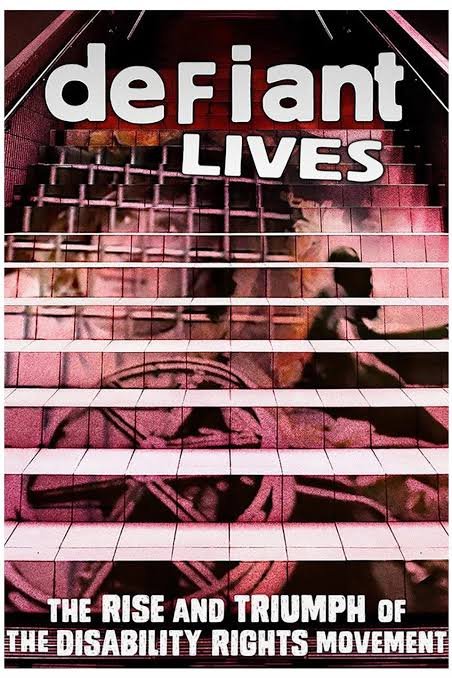
Defiant Lives Disability Rights Lesson
Students will watch “Defiant Lives: The Rise and Triumph of the Disability Rights Movement in the United States, England, and Australia.” It covers important milestones in disability activism, from breaking people out of nursing homes to advocating for equal rights. The discussion topics in the film vary from institutionalization to passing legislation. The film highlights in particular, the vast differences between the medical model of disability and the social model of disability. For 5 days, students will watch a segment of the film and record their own thoughts and then discuss their thoughts with a partner and the full group. The last two days students will work together to create their own plan to address an issue in their own community.
Image description: Defiant Lives poster showing stairs and projected onto the stairs is a pink and black wheelchair and disability activist. Text at the top says Defiant Lives and text at the bottom says the Rise and Triumph of the Disability Rights Movement

Demystifying Pennhurst State School Lesson
In this lesson students will compare and contrast 3 videos on Pennhurst State School. Students will delve into two narratives, The “horror” and “historical”. In a class discussion, students will discuss the implications of each narrative on how society views mental illness and intellectual disability. Students will learn about Pennhurst and the historic self-advocacy of the residents and the eventual closing of the PA institution.
Image description: Black and white photograph of Pennhurst
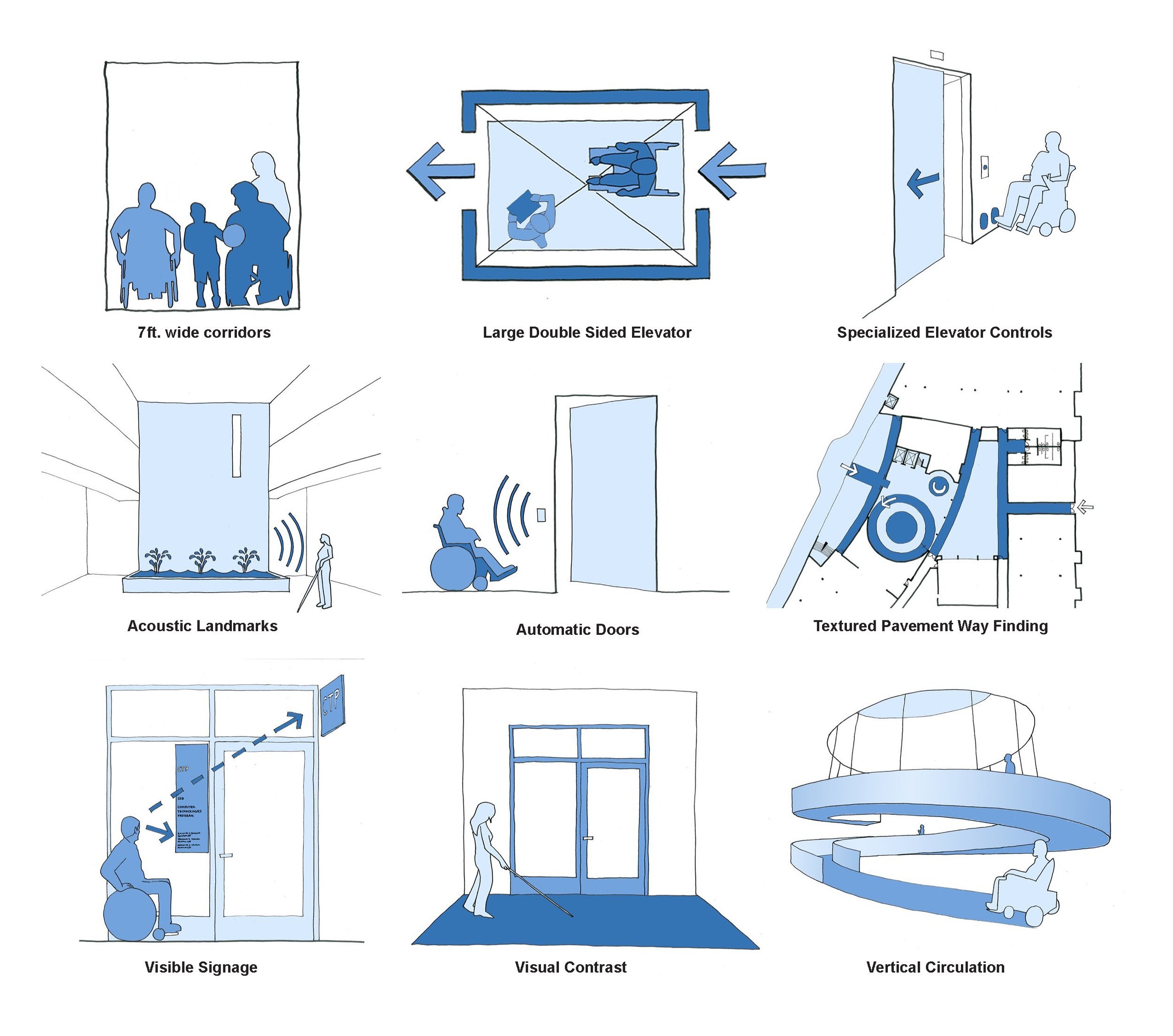
Designing with Disability in Mind
This lesson plan combines geometry with social awareness by exploring some of the principles of universal design and accessibility.
Over two class periods, students review key geometric concepts such as area, perimeter, and volume, and apply these concepts to redesign public spaces to meet accessibility standards. Through video content, class discussions, and hands-on design activities, students learn the importance of creating inclusive environments for people with disabilities. To share their work and demonstrate their learning, students will engage in a “gallery walk” to debut their group presentations of redesigned floor plans.
Image Description: Graphic showing 9 features of accessible design used at the Ed Roberts Campus

“Different: A Great Thing to Be!” - Similarities and Differences Lesson
This lesson has five activities which can be spread between multiple days as time allows within English Language Arts blocks. Through a teacher-led interactive read aloud and whole class discussion of the story: “Different: A Great Thing to Be” by Heather Avis, students will be encouraged to identify similarities between themselves and the main character in the story, Macy, and their classmates, as well as embrace differences within themselves, Macy and their classmates.
Image Description: a light purple background with 7 different colorful birds standing on a thin branch. The text above says “Each of us is different and that’s a good thing!” The word different is bigger and each letter is in vibrant different colorful patterns.