
Disability History Timeline Lesson
This lesson is meant to accompany Disability Equality in Education’s Disability History Timeline. Printable images are included in the materials to use with this lesson. In this lesson, students will select a moment from disability history and analyze its importance.
Image description: tiles from DEE”s Disability History Timeline on the wall

Disability Justice Lesson Plan - Education Amplifier
In this lesson plan, you’ll find six modules that you can mix and match, that all teach about different aspects of disability rights and disability justice.
Image Description: Education Amplifier’s illustration of Lydia X.Z. Brown
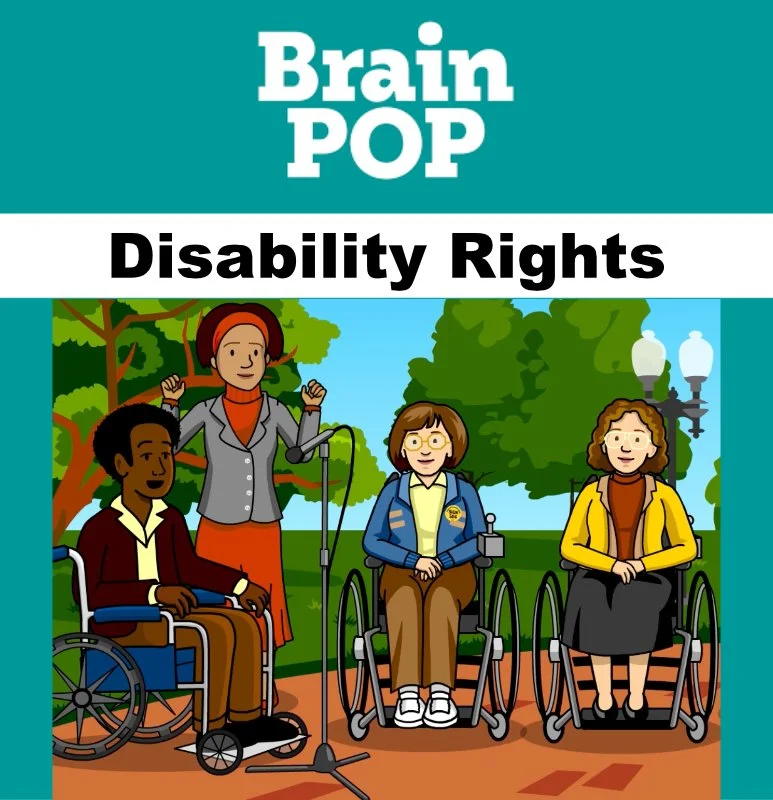
Disability Rights Lesson by BrainPOP
This BrainPop video and associated resources introduce the Disability Rights movement through the fight for Section 504, the law that paved the way for the Americans with Disabilities Act.
Image Description: BrainPOP logo, “Disability Rights” and animated screenshot from the video showing 4 people outdoors, 3 are seated in wheelchairs, one is standing in front of a microphone.

Disability Rights as Human Rights: The Role of the Convention on the Rights of Persons with Disabilities (CRPD)
Through reading selections of the United Nations Convention on the Rights of Persons with Disabilities (CRPD), students will explore the role of international agreements in shaping national policies. They will engage with key human rights vocabulary, analyze how the CRPD has influenced disability rights worldwide, and explore issues pertaining to US non-ratification. This lesson encourages critical thinking about disability as a civic and human rights issue, emphasizing the responsibilities of governments in upholding equality and justice. Differentiation strategies for middle vs high school students would include using the original vs easy-read version of the text, as well as differentiated discussion questions.
Image Description: Left, United Nations emblem consisting of a world map surrounded by two olive branches, all in white on a blue background. Right, CRPD logo, each letter on its own in white on a maroon square arranged in a 2×2 grid. To the right are the words “Convention on the Rights of Persons with Disabilities” in maroon.

Emerging America - The Long Struggle for Disability Rights
Summary:
An introduction helps establish safe and respectful study of disability history. In lesson 1, students the Question Formulation Technique helps develop questions. Then a presentation highlights disabled advocates across American history. In lesson 2, students research the causes, goals and methods, successes and setbacks of the Disability Rights Movement. Students present research with multiple media options: talk with slides, podcast, video, essay, or poster. Lesson 4 guides a genuinely inclusive civic engagement project.
Image Description: Emerging America logo above text that reads “Grades 9-12: The Long Struggle for Disability Rights” above a black and white photo of ADAPT protesters seated on the ground and in wheelchairs holding signs c. 1980s

Emerging America - Disability in the Progressive Era
Summary:
An introduction to disability helps establish safe and respectful study of a difficult topic. Students examine eugenics policy, including forced sterilization and examine how values change. Primary sources include challenges to eugenics from the 1930s as well as 21st century efforts to come to terms with its impacts. The grades 4-5 lesson 2 on immigration policy can provides primary sources and guiding questions that can provide solid support to expand this unit. Unit resources support optional research projects.
The material is emotionally difficult. It is essential to create a safe space for all, including students who might relate personally to the topic. Particular attention is required to ensure that discussion respects students of varied views. It is vital to clarify that universal norms of democracy today are clear that there is no valid justification for the program of eugenics and that its claims were in no way supported by valid science.
Image Description: Emerging America logo above text that reads “Grades 9-12: Disability in the Progressive Era” above a black and white photo of William H. Taft, Oliver Wendell Holmes, Jr. and others in front of the White House. c.1922

Emerging America - How Civil War Veterans Transformed Disability
Summary:
All the grades 8-10 units begin with a brief introduction to the topic. Lessons 1 & 2 could anchor study of the Second Great Awakening and other reforms of the period or integrate within a larger unit. Lesson 2 introduces some of the problems with larger-scale institutionalization and thus could provide a foundation for further study of the exposés and struggles for independent living throughout the 20th century.
Image Description: Emerging America logo above text that reads “Grades 8-10: How Civil War Veterans Transformed Disability” above a black and white photo of the Wounded from the Battle of the Wilderness c. 1864

Emerging America - Founding of Schools and Asylums
Summary:
All the grades 8-10 units begin with a brief introduction to the topic. Lessons 1 & 2 could anchor study of the Second Great Awakening and other reforms of the period or integrate within a larger unit. Lesson 2 introduces some of the problems with larger-scale institutionalization and thus could provide a foundation for further study of the exposés and struggles for independent living throughout the 20th century.
Image Description: Emerging America logo above text that reads “Grades 8-10: Founding of Schools and Asylums” above a sepia-toned lithograph of the American School for the Deaf c. 1881

Emerging America - Disability, Civic Engagement, and Government
Summary:
This unit works particularly well in a course on civics and government. The intro lesson introduces key information and can be useful to check student knowledge and experiences. Lesson 1 is essential to introduce the unit's study of disability. Lessons 2 & 3 delves into work for disability rights, including transformative legislation. In lesson 4, students apply what they have learned about civic action to research, plan, and carry out their own civic engagement project. (This lesson is also used for Grades 9-12.) Lesson 5 can stand alone or fit within the unit; it adds disability rights as an option for study of historic Supreme Court cases.
Image Description: Emerging America logo above text that reads “Grades 6-8: Disability, Civic Engagement, and Government” above a black and white photo of an ADAPT Protest c. 1990

Emerging America - Disability, Citizenship, and Civil Rights
Lesson Summary:
Lesson 1 is essential to introduce study of disability. Lesson 2 integrates disability into study of immigration. This lesson could also stand alone, or it could support a larger immigration unit. Lessons 3 & 4 work together but could also work separately. All three lessons can be taught in one grade or introduced over multiple grades.
Image Description: Emerging America logo above text that reads “Grades 4-5: Disability, Citizenship, and Civil Rights” above a black and white photo of George Veditz presenting Preservation of the Sign Language in American Sign Language. c. 1913

Emerging America - Disability and Community Leadership Unit
Lesson Summary: In lesson 1, students explore primary sources and their own experiences to become familiar with ideas about disability and ways that students, their community, and their school can support access for everyone. In lesson 2, students identify and agree to ways to make decision-making inclusive. Students discuss characteristics of good leaders using illustrated stories of disability advocates. In lesson 3, students explore a case study of disability advocacy to dig deeper into how civic leaders strengthen their communities.
All three lessons can be taught in one grade or introduced over multiple grades.
Image Description: Emerging America logo at top with text reading “Grades K-3: Disability and Community Leadership” above a black and white photo of Eleanor Roosevelt visiting children at Langford School. c.1930

Everyone Spoke Sign Language - The Chilmark Deaf Community
In this lesson, students consider how people communicate when they do not speak a common language. The Chilmark Deaf Community serves as a case study to engage with the wide variety of languages spoken on the Island (presently and in the past). From 1694 to 1952, Martha’s Vineyard - and specifically the towns of Chilmark and West Tisbury - had an unusually large population of people with hereditary deafness. As a result, the residents of the Island developed a local dialect of sign language, used by hearing and deaf people alike, allowing the Deaf community full and unbiased integration into Island society at large. Scientists and researchers studying the causes of deafness took great interest in Martha’s Vineyard because of deafness’ prevalence there.
Image Description: A mural with 4 simplistic cartoon-style characters drawn in black on a light tan background using sign language, movements are shown with arrows. There is foliage at the bottom and a brick wall at the top of the photograph.

Exploring Nancy Polette’s “The Spy with the Wooden Leg: The Story of Virginia Hall” with the help of a reading journal
The students will learn how to use a reading journal to aid their exploration of a biography “The Spy with the Wooden Leg: The Story of Virginia Hall” which will be read as a class and individually. This reading will be slow in order to help support students’ discovering how to read, process, and reflect upon biography in the form of a chapter book and use this information to enrich their study of History. Many aspects of this lesson are flexible and can be adapted to the needs of your students.
Some themes of war may be difficult for some students, it is recommended that no new difficult content be introduced on a Friday or before a long break so that the class can have the support they need as they learn about these difficult themes.
Image Description: cover of the book “The Spy with the Wooden Leg: The Story of Virginia Hall By Nancy Polette”

The Fight for Disability Rights Lesson by Junior Scholastic
A lesson plan based on the Scholastic article “The Fight for Disability Rights,” where students learn about the Americans with Disabilities Act.
Image Description: Junior Scholastic logo above text “The Fight for Disability Rights” and a photo of Judy Heumann speaking at a rally in 1977. She is wearing a big round button that says “Sign 504”
FDR Hiding his Disability Lesson
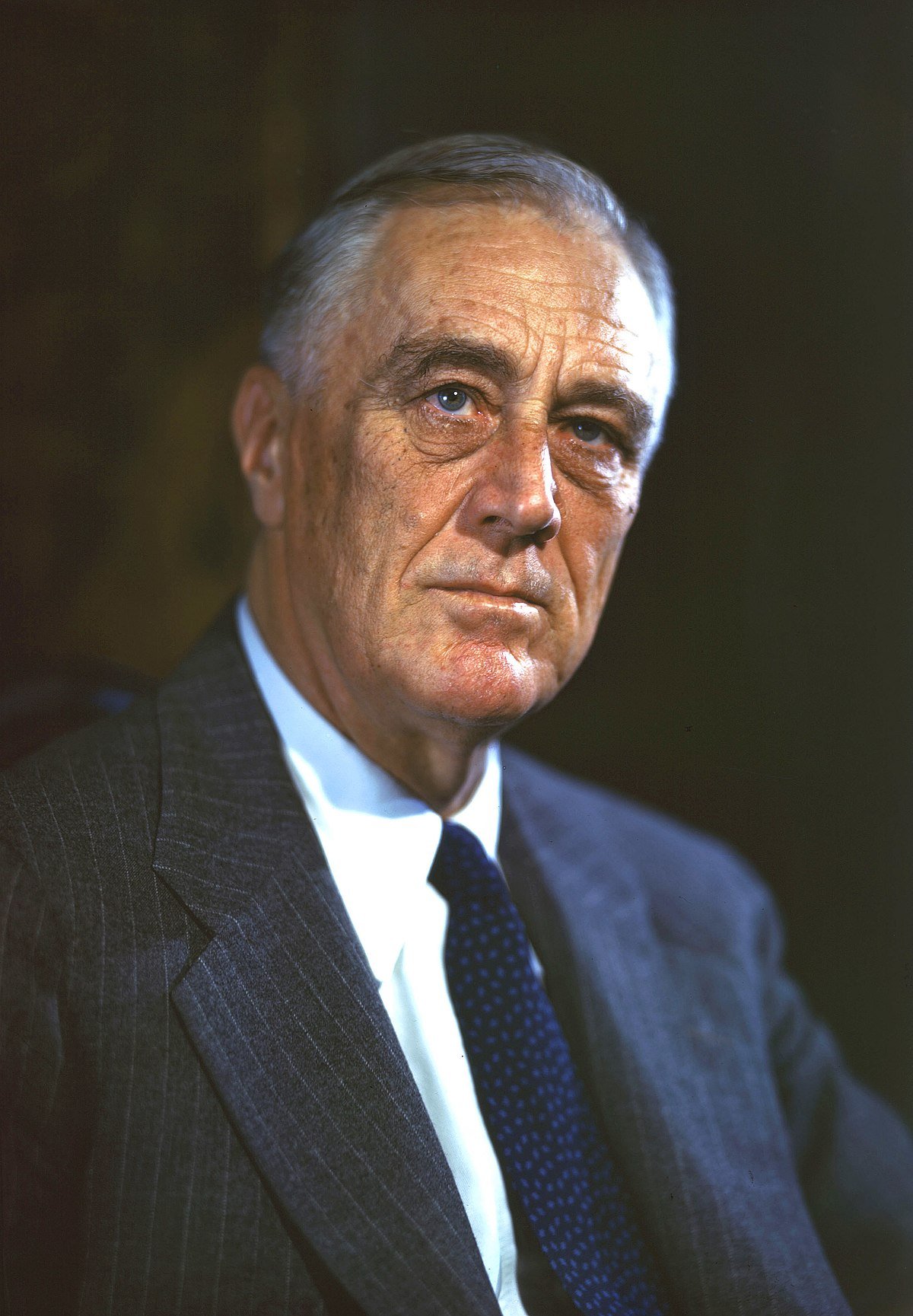
Students will engage in discussion about the Stigma associated with disability. They will then learn about FDR and how illness made him lose the ability to fully walk. They will then learn about how FDR, the people around him, and the press worked to keep his disability as secret as possible. This will lead to a discussion about the impact of his decision to hide his disability, and how taking a prideful approach to his disability could have changed how people perceived him and others with disabilities.
Image description: photograph of Franklin D. Roosevelt

Global Development of Disability Rights: Timeline and Maps
High school students will explore the development of disability rights within various countries and time periods. Working together in groups, students will select a country of focus. Each group will collaborate to create timelines and maps, trace key events, legislation, and influential figures surrounding disability in their country.
This lesson fosters a deeper understanding of how geographical and historical contexts have shaped the accessibility and inclusion of people with disabilities. Through research and analysis of primary and secondary sources, students will develop their skills in historical inquiry and geographical interpretation, while gaining a comprehensive view of the global disability rights movement.
Image Description: blue accessible icon on a cloud background with a blue and green globe in the center of the wheelchair’s wheel.

Hephaestus - Greek Mythology
Students will read about Hephaestus. After reading each passage, they will be able to reflect and write about how Hephaestus is portrayed in that specific passage. Using evidence from each passage, the students must justify their opinions.
Image description: Statue of Hephaestus
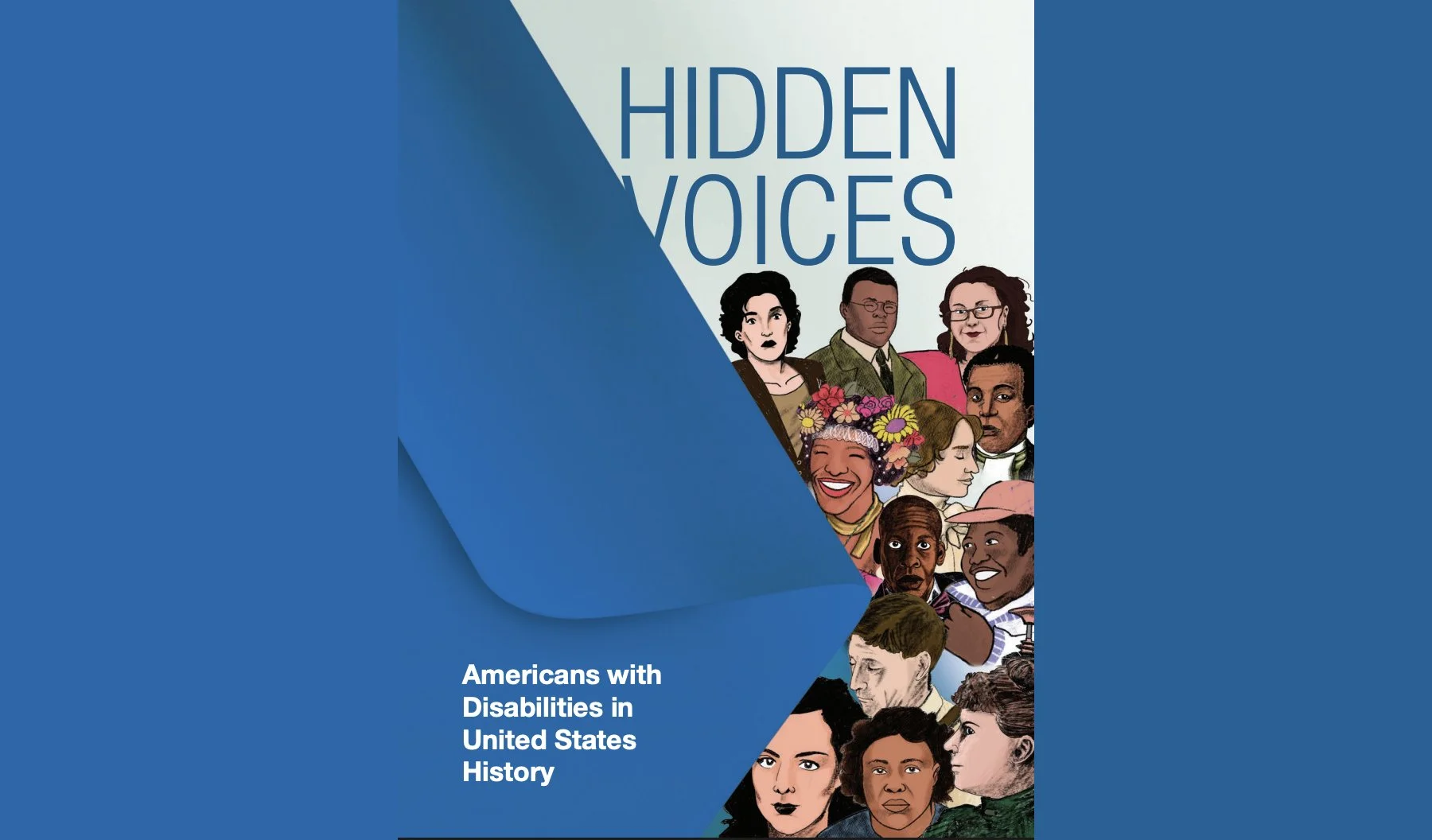
Hidden Voices: Americans with Disabilities in United States History
Hidden Voices: Americans with Disabilities in United States History introduces students to the often-overlooked contributions of Americans with disabilities throughout U.S. history. Through 42 biographical profiles, the resource highlights diverse experiences and impacts on social, political, cultural, and economic life. Each profile includes questions, images, curriculum connections, and resources to support analysis, making it adaptable across grades and subjects while fostering understanding and empathy.
Image Description: Text reads “Hidden Voices, Americans with Disabilities in United States History” along with a collage of illustrated portraits of people

Hispanic Heritage: Frida Kahlo (Intersectionality of Ableism, Creativity and Feminism) Lesson
Frida Kahlo (1907 - 1954) was a Mexican artist who was influenced by the Mexican Revolution. She experienced a disability at two times in her life. Her determinism helped her cope with the pain of overcoming polio, a difficult marriage and bus-trolley accident. Frida Kahlo’s curiosity and love for nature were often the subjects of her paintings. Known as the “mother of the selfie,” Frida also created more than 200 paintings of herself. This unit of lessons is to recognize the creativity and imagination of Frida Kahlo.
Image description: Photograph of Frida Kahlo against a green floral background

History of Eyeglasses: The Importance of Adaptive Equipment
In this lesson, students will learn about science, history and geography related to eyeglasses. First, they will consider the history of eyeglasses, their impact on vision impairments, and how they are so widespread in America (and other high-income countries) that wearing them is rarely considered to indicate a vision issue; in fact, they are often fashion statements. Then they will explore how access to glasses differs around the world, specifically considering barriers that prevent access. Finally, they will choose their own adaptive device (a list of ideas is provided, but students are welcome to choose their own), and create an infographic that explains: the important benefits to widespread usage of their chosen device, current barriers, and suggest possible solutions.
Image Description: “History of Eyeglasses: The Importance of Adaptive Equipment” in black text on a light green box. On all sides is about a dozen black eyeglasses scattered on a white background.