
Emerging America - Disability, Civic Engagement, and Government
Summary:
This unit works particularly well in a course on civics and government. The intro lesson introduces key information and can be useful to check student knowledge and experiences. Lesson 1 is essential to introduce the unit's study of disability. Lessons 2 & 3 delves into work for disability rights, including transformative legislation. In lesson 4, students apply what they have learned about civic action to research, plan, and carry out their own civic engagement project. (This lesson is also used for Grades 9-12.) Lesson 5 can stand alone or fit within the unit; it adds disability rights as an option for study of historic Supreme Court cases.
Image Description: Emerging America logo above text that reads “Grades 6-8: Disability, Civic Engagement, and Government” above a black and white photo of an ADAPT Protest c. 1990

Emerging America - Disability, Citizenship, and Civil Rights
Lesson Summary:
Lesson 1 is essential to introduce study of disability. Lesson 2 integrates disability into study of immigration. This lesson could also stand alone, or it could support a larger immigration unit. Lessons 3 & 4 work together but could also work separately. All three lessons can be taught in one grade or introduced over multiple grades.
Image Description: Emerging America logo above text that reads “Grades 4-5: Disability, Citizenship, and Civil Rights” above a black and white photo of George Veditz presenting Preservation of the Sign Language in American Sign Language. c. 1913

Emerging America - Disability and Community Leadership Unit
Lesson Summary: In lesson 1, students explore primary sources and their own experiences to become familiar with ideas about disability and ways that students, their community, and their school can support access for everyone. In lesson 2, students identify and agree to ways to make decision-making inclusive. Students discuss characteristics of good leaders using illustrated stories of disability advocates. In lesson 3, students explore a case study of disability advocacy to dig deeper into how civic leaders strengthen their communities.
All three lessons can be taught in one grade or introduced over multiple grades.
Image Description: Emerging America logo at top with text reading “Grades K-3: Disability and Community Leadership” above a black and white photo of Eleanor Roosevelt visiting children at Langford School. c.1930

Everyone Spoke Sign Language - The Chilmark Deaf Community
In this lesson, students consider how people communicate when they do not speak a common language. The Chilmark Deaf Community serves as a case study to engage with the wide variety of languages spoken on the Island (presently and in the past). From 1694 to 1952, Martha’s Vineyard - and specifically the towns of Chilmark and West Tisbury - had an unusually large population of people with hereditary deafness. As a result, the residents of the Island developed a local dialect of sign language, used by hearing and deaf people alike, allowing the Deaf community full and unbiased integration into Island society at large. Scientists and researchers studying the causes of deafness took great interest in Martha’s Vineyard because of deafness’ prevalence there.
Image Description: A mural with 4 simplistic cartoon-style characters drawn in black on a light tan background using sign language, movements are shown with arrows. There is foliage at the bottom and a brick wall at the top of the photograph.
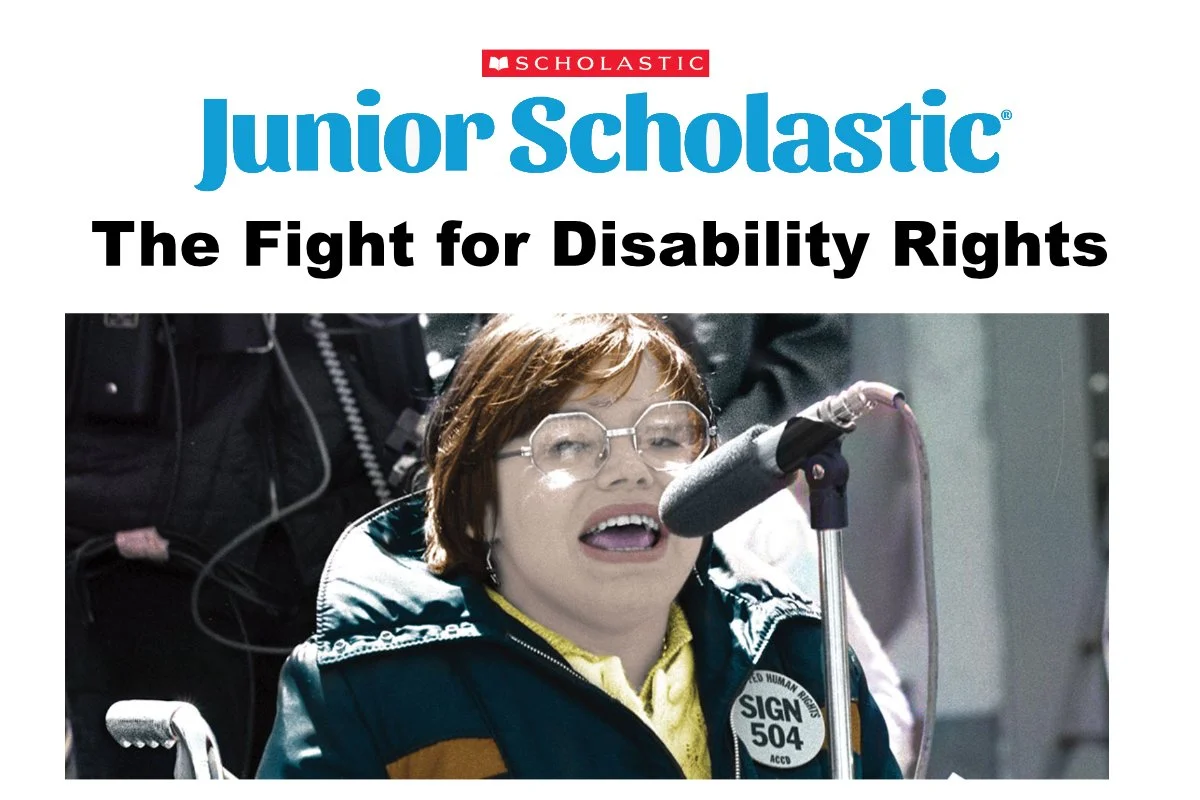
The Fight for Disability Rights Lesson by Junior Scholastic
A lesson plan based on the Scholastic article “The Fight for Disability Rights,” where students learn about the Americans with Disabilities Act.
Image Description: Junior Scholastic logo above text “The Fight for Disability Rights” and a photo of Judy Heumann speaking at a rally in 1977. She is wearing a big round button that says “Sign 504”
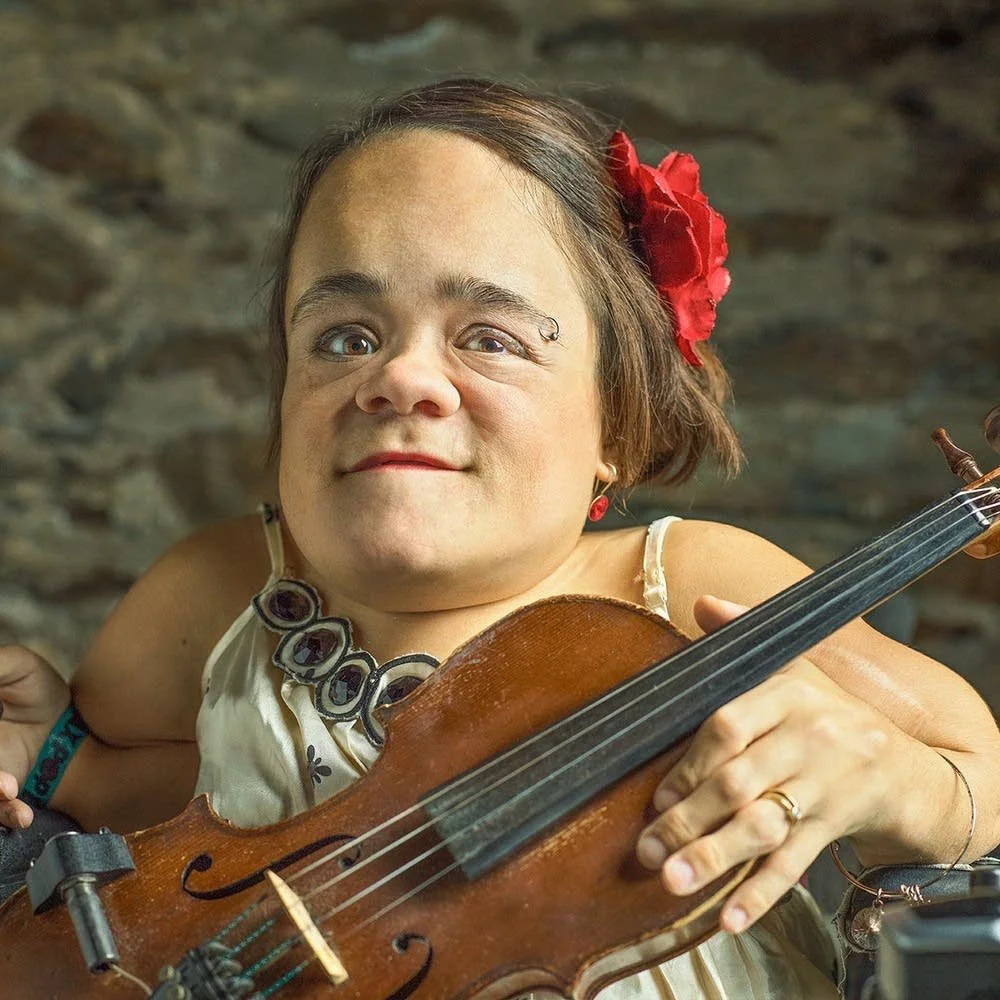
Gaelynn Lea Music Lessons by Your Classical Class Notes / Minnesota Public Radio and Gaelynn Lea
Gaelynn Lea is a violinist, singer, and songwriter from Duluth, Minnesota. These free resources from YourClassical Class Notes use her music and practice as the basis for K-6 music lessons on songwriting, instrument technique, and music technology. A disability-informed teaching note follows the resource descriptions below.
Image Description: Photo of Gaelynn Lea holding her violin diagonal across her body.
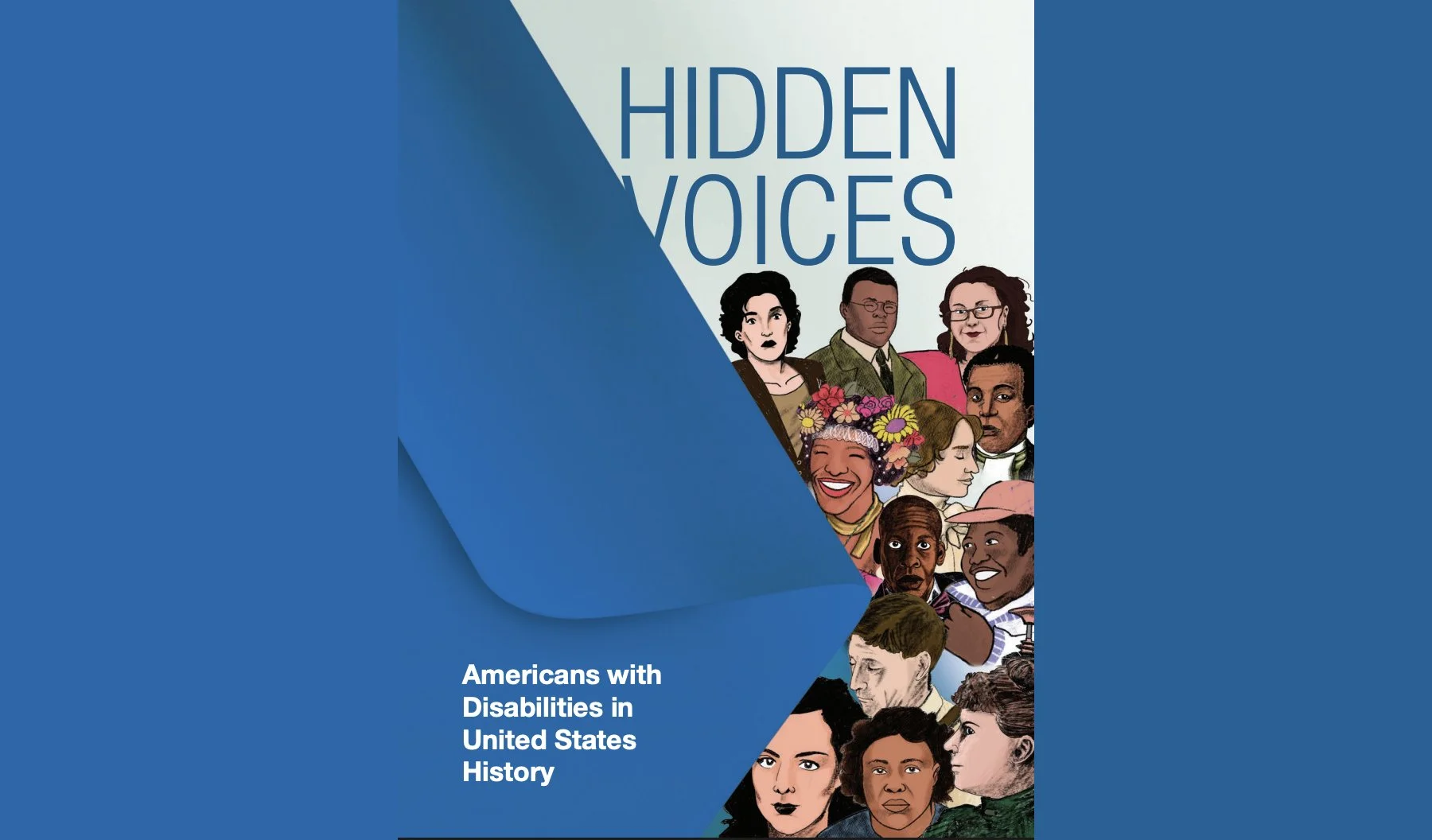
Hidden Voices: Americans with Disabilities in United States History
Hidden Voices: Americans with Disabilities in United States History introduces students to the often-overlooked contributions of Americans with disabilities throughout U.S. history. Through 42 biographical profiles, the resource highlights diverse experiences and impacts on social, political, cultural, and economic life. Each profile includes questions, images, curriculum connections, and resources to support analysis, making it adaptable across grades and subjects while fostering understanding and empathy.
Image Description: Text reads “Hidden Voices, Americans with Disabilities in United States History” along with a collage of illustrated portraits of people

The New York Times - ‘26.2 Miles Is Easy. Getting Around New York City Is Not.’ - Lesson Plan
In this lesson, students will learn why it’s easier for one athlete to win a marathon in New York than to navigate the city in a wheelchair. Then, students will evaluate the accessibility of public spaces where they live.
Image Description: "The Learning Network Teaching & Learning with the New York Times" Below the text is a photograph of Daniel Romanchuk in his racing wheelchair crossing a busy street at a crosswalk.

The New York Times - ‘The Hidden Image Descriptions Making the Internet Accessible’
In this lesson, students will learn about alt text, and image descriptions that help people who have low vision or are blind to use the internet. Then, they will practice using the feature.
Image Description: "The Learning Network Teaching & Learning with the New York Times" Below the text is the Mona Lisa with 3 examples of alt text descriptions from Microsoft Word, Facebook and Wikipedia.

New York Times: Learning With: ‘Adaptive Video Game Controllers Open Worlds for Gamers With Disabilities’
This lesson explores how adaptive video game controllers are transforming gaming for players with disabilities. Students will first reflect on their own gaming experiences before analyzing a commercial and reading an article about accessibility in gaming. Through discussion questions, they will examine the challenges faced by disabled gamers, how technology has evolved to be more inclusive, and the broader impact of adaptive controllers. The lesson encourages critical thinking about accessibility in technology and invites students to consider how they would design more inclusive gaming experiences.
Image Description: "The Learning Network Teaching & Learning with the New York Times" Below the text is a photo of Erin Hawley playing video games with her family. She uses an adaptive controller.

One Out of Five lesson series
The purpose of this lesson is to humanize the experience of disability by focusing on student-voice videos, recognize diversity within the disability community, and discuss ways to promote accessibility. This is the first in a series of 5 lessons by Washington State’s One Out of Five Disability History and Pride Project.
Image Description: Groups of students sit and stand, talking in clusters. The profiles of the students of different ages, races, and abilities is on a colorful background of yellow, orange, and green. The dominant image is the silhouette of a male student in dark blue reading a book. The title is: One Out of Five: Disability History and Pride Project. “One” and “five” are spelled out in American Sign Language. At the bottom, Braille reads: “pride” and “history.”]

Patient No More: People with Disabilities Securing Civil Rights
Teaching the story of the 504 occupation, the focus of the Patient No More exhibit, will undoubtedly leave students with a new perspective toward living with a disability. “Patient No More” offers a story about the creativity and strength that comes out of the disability community, an incredible example of how change can happen from the bottom up. It's also a story about how disability rights have changed the lives of all Americans in ways they might not realize.
Image Description: “Patient No More - People with disabilities securing civil rights” black and white photo of protestors with capitol building in the background, many in wheelchairs, one with a sign on the back of their wheelchair that says “We Shall Overcome”
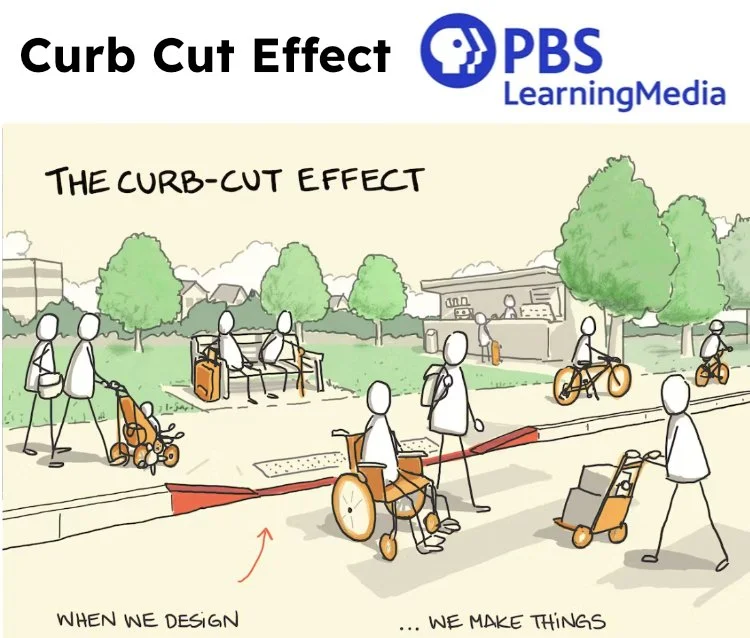
PBS Learning Media - The Americans with Disabilities Act (ADA) and the Curb-Cut Effect | Interactive Lesson
Students explore the history of curb cuts, from early disability rights advocacy in the 1940s through the passage of the Americans with Disabilities Act in 1990, and examine how accessibility features designed for disabled people often benefit far broader communities. Through an interactive lesson and writing prompt, students consider how civic engagement by a specific group can shape policy in ways that serve everyone.
Image Description: “Curb Cut Effect” in black text “PBS Learning Media” in blue text with the PBS logo. Below the text is an illustration using stick figures in a street scene showing a curb cut and a variety of wheelchairs and other wheeled things with the people using them
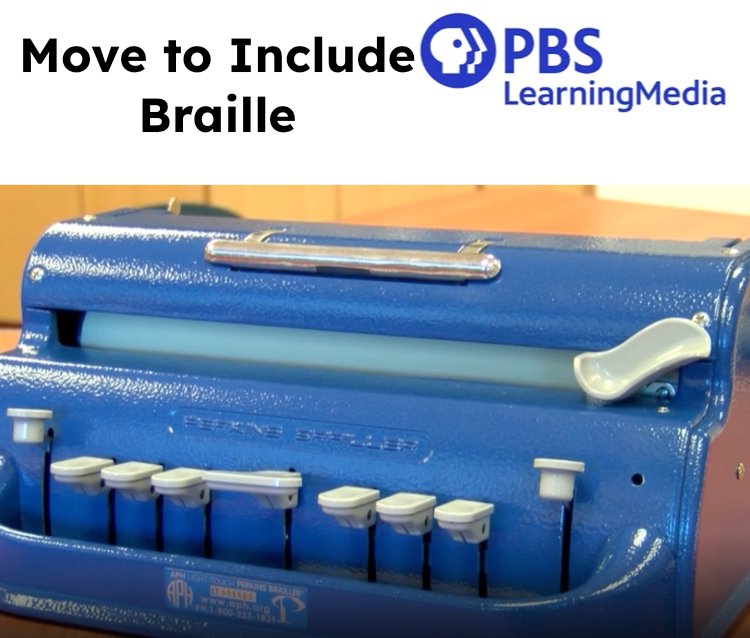
PBS Learning Media - Braille | Move to Include
Students watch a short video introducing Braille as a tactile literacy system and learn how it works as a code of raised dots representing letters and words. Through background reading and discussion questions, students explore how Braille functions as a tool for access and consider how technology has expanded the ways blind, low-vision, and deaf-blind people interact with written language.
Image Description: “Move to Include” in black text “PBS Learning Media” in blue text with the PBS logo. Below the text is a blue brailler.

PBS Learning Media - Renegades Lessons
Summary:
Renegades is a documentary series from American Masters that showcases the lives and cultural contributions of little-known historical figures with disabilities. These lessons were designed to be used with the videos. They can be used individually or as a unit.
Image Description: “Renegades” in black text “PBS Learning Media” in blue text with the PBS logo. below the text are a series of 5 colorful images from each of the 5 short films. Left to right, Brad Lomax, Celestine Tate Harrington, Daniel K. Inouye, Judy-Lynn Del Ray, and Thomas Wiggins

Portrait of the Whole Person - Disability Rights Washington
Portrait of the Whole Person is a curriculum for elementary school students designed to teach students how disability rights fit into the broader civil rights movement, to perceive disability as a reflection of societal views of differences, and to treat people with disabilities with respect and dignity. It contains four distinct lesson plans comprised of three in-class instruction lesson plans and one lesson plan governing the research and writing of a biographical sketch and creation of a portrait of a notable person with a disability. It is also complete with a graphic organizer, rubrics, a power point, and a list of references students can use for research.
Image Description: Disability Rights Washington logo with “Portrait of a Whole Person Curriculum Overview” written below and drawings of 3 different people in colored pencil.

Posters with Disability Inclusive Content
Posters with disability representation. Most are free to download, though some can be purchased as well.
Image description: Corkboard wall with many signs of assorted size and colors.

We Will Ride Lesson by Pop Culture Classroom
In this lesson students will read a 2-page graphic novel format story about the Gang of 19 and “We Will Ride” action, and how they fought for equal rights for the disabled.
Image Description: Graphic Novel cover showing protesters in purple black and off white on a green background with the title “Colorful History Comics #31 We Will Ride” underneath the comic.