The Fight for Disability Rights Lesson by Junior Scholastic
A lesson plan based on the Scholastic article “The Fight for Disability Rights,” where students learn about the Americans with Disabilities Act.
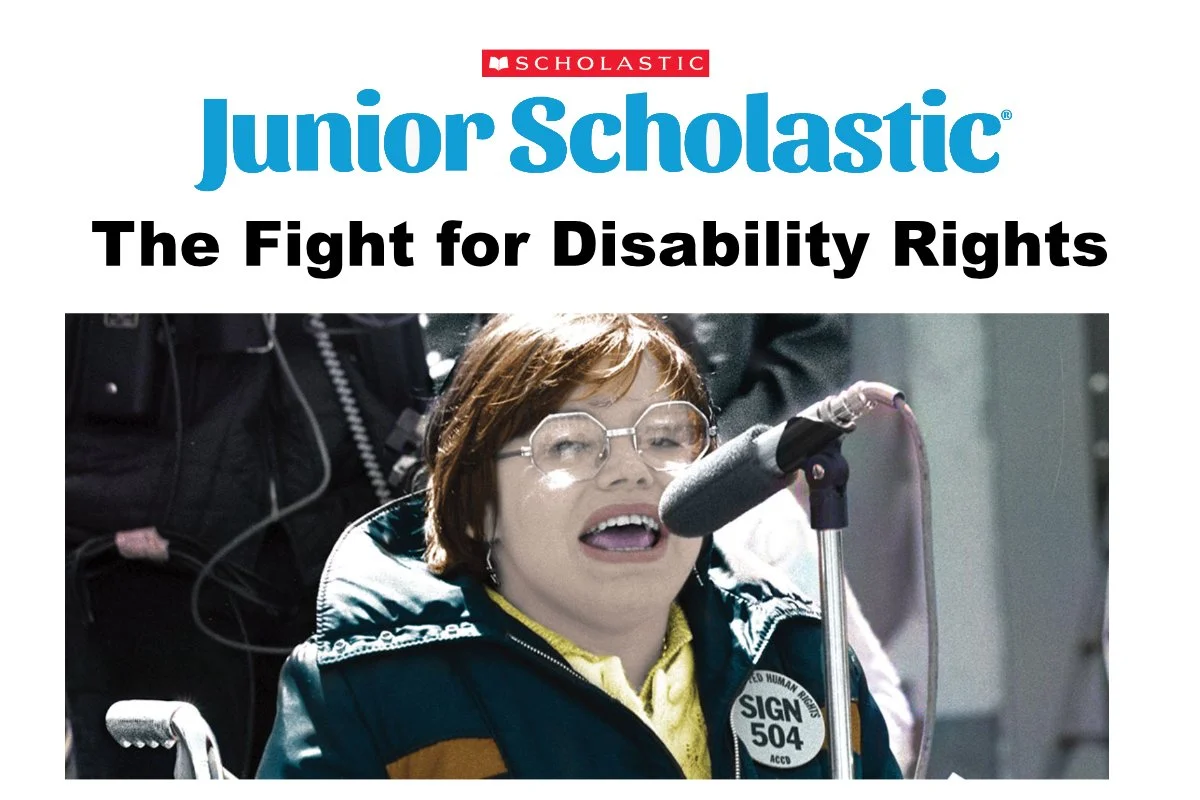
Image Description: Junior Scholastic logo above text “The Fight for Disability Rights” and a photo of Judy Heumann speaking at a rally in 1977. She is wearing a big round button that says “Sign 504”
Gaelynn Lea Music Lessons by Your Classical Class Notes / Minnesota Public Radio and Gaelynn Lea
Gaelynn Lea is a violinist, singer, and songwriter from Duluth, Minnesota. These free resources from YourClassical Class Notes use her music and practice as the basis for K-6 music lessons on songwriting, instrument technique, and music technology. A disability-informed teaching note follows the resource descriptions below.
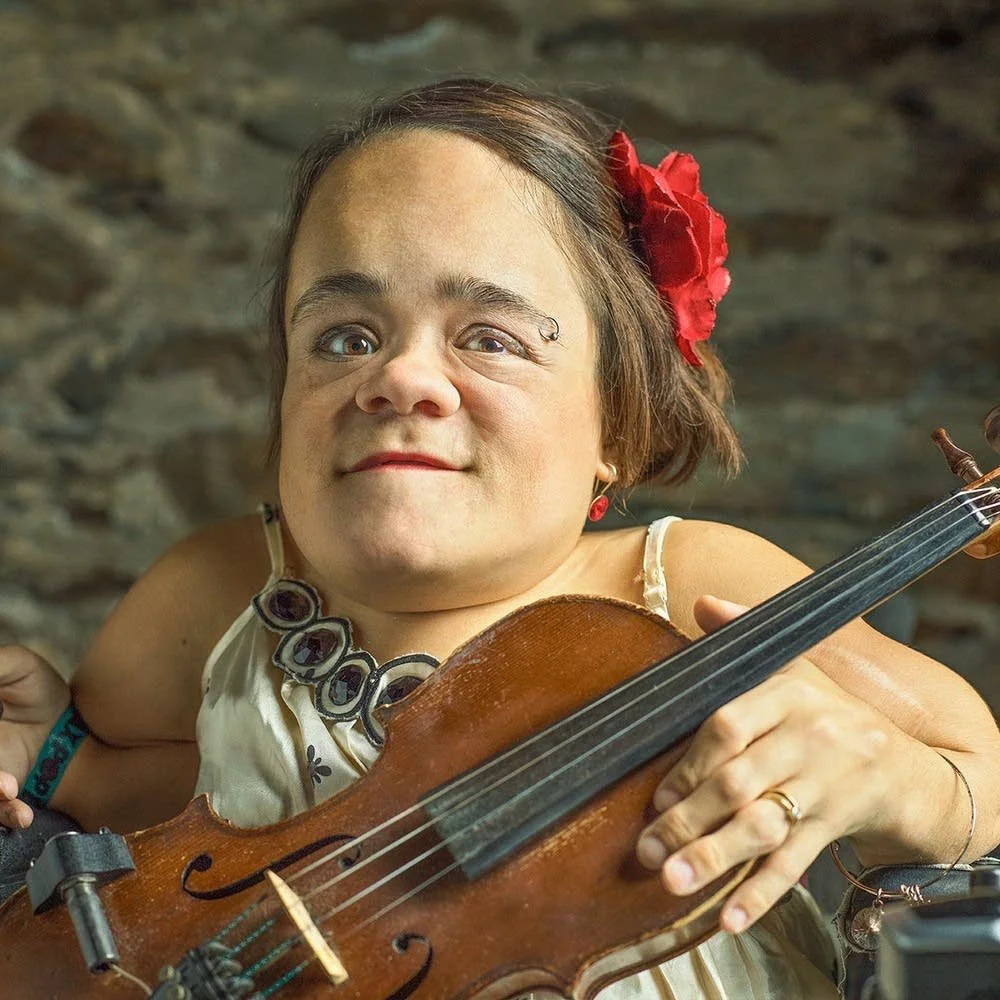
Image Description: Photo of Gaelynn Lea holding her violin diagonal across her body.
The Giver: Disability Informed Reading Guide
The Giver: Disability Informed Reading Guide
Image Description: “The Giver: Disability Informed Reading Guide” pale yellow background with black text. Simple black book with white pages graphic.

Happy Paintings - The Art of Maud Lewis
In this lesson, students will learn about the art of Maud Lewis, a prolific Canadian folk artist who lived in rural Nova Scotia (Eastern Canada, near the Atlantic Ocean), and worked in the mid-20th century. She is now believed to have been born with juvenile rheumatoid arthritis, but it was not diagnosed or treated in her lifetime. Students will learn about her artwork, rooted deeply in the place where she lived, and have the opportunity to keep a sketchbook for a week, and create a painting in Maud Lewis’ style that reflects their own local world. Students will also consider the complex intersections between disability, poverty and the arts that are embedded in Maud’s life story.
Image Description: a painted clam shell that features a red birdhouse in the center, surrounded by colorful flowers and two blue birds on either side. The shell is mounted on a wooden background. The artist's name, "Maud Lewis," is visible on the shell.
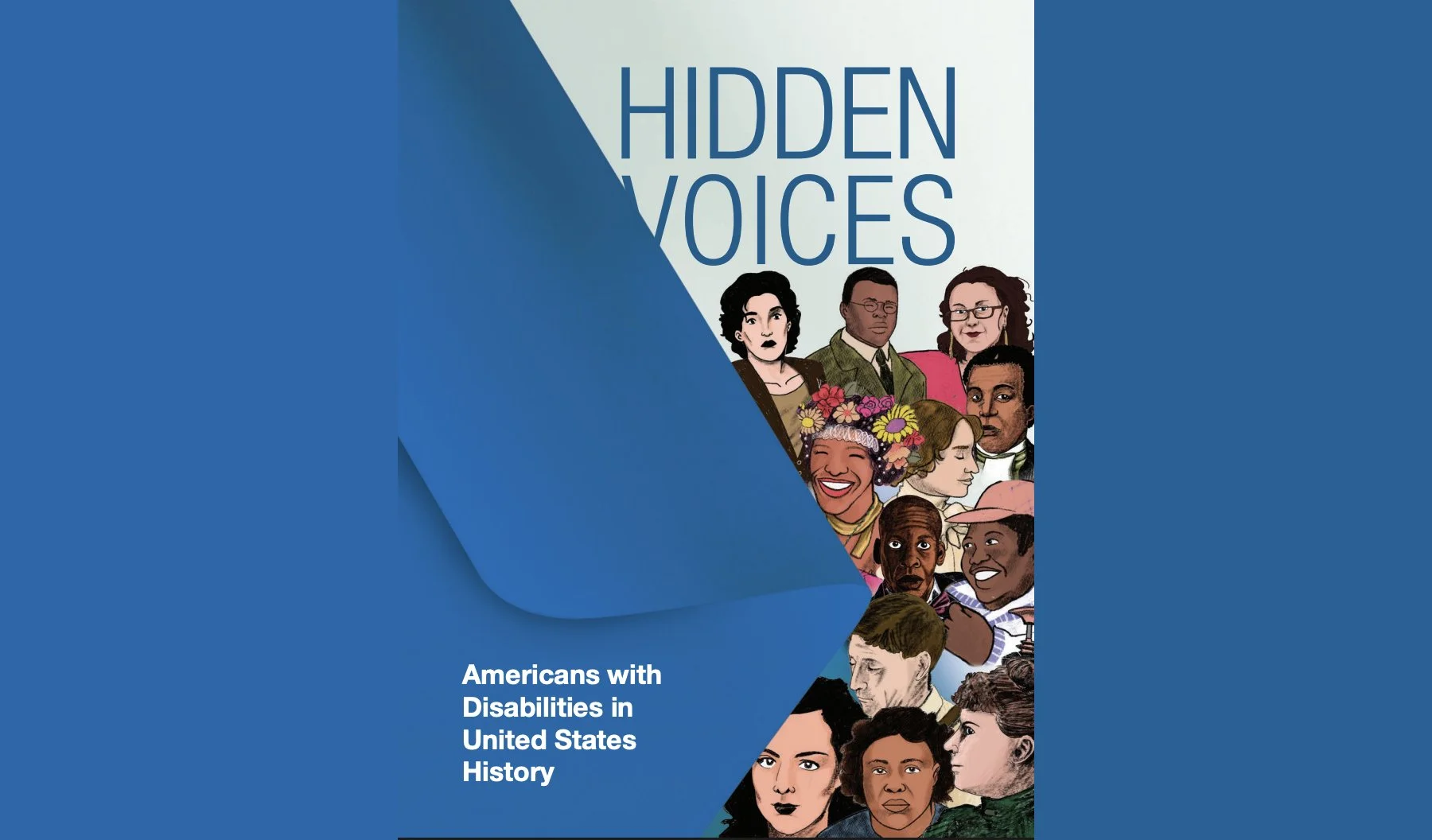
Hidden Voices: Americans with Disabilities in United States History
Hidden Voices: Americans with Disabilities in United States History introduces students to the often-overlooked contributions of Americans with disabilities throughout U.S. history. Through 42 biographical profiles, the resource highlights diverse experiences and impacts on social, political, cultural, and economic life. Each profile includes questions, images, curriculum connections, and resources to support analysis, making it adaptable across grades and subjects while fostering understanding and empathy.
Image Description: Text reads “Hidden Voices, Americans with Disabilities in United States History” along with a collage of illustrated portraits of people
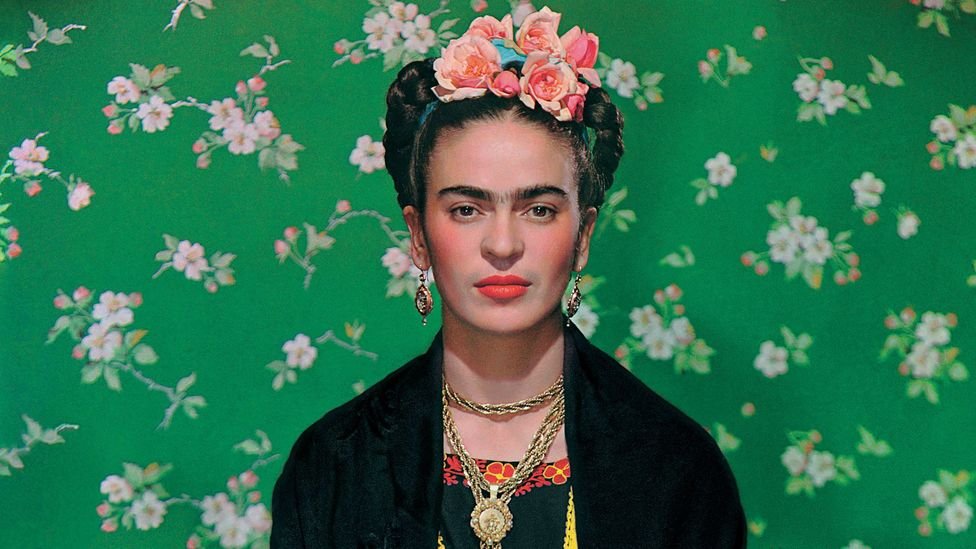
Hispanic Heritage: Frida Kahlo (Intersectionality of Ableism, Creativity and Feminism) Lesson
Frida Kahlo (1907 - 1954) was a Mexican artist who was influenced by the Mexican Revolution. She experienced a disability at two times in her life. Her determinism helped her cope with the pain of overcoming polio, a difficult marriage and bus-trolley accident. Frida Kahlo’s curiosity and love for nature were often the subjects of her paintings. Known as the “mother of the selfie,” Frida also created more than 200 paintings of herself. This unit of lessons is to recognize the creativity and imagination of Frida Kahlo.
Image description: Photograph of Frida Kahlo against a green floral background

Infinite Motifs - the Art of Yayoi Kusama
In this lesson, students will learn about the paintings of Yayoi Kusama, an artist from Japan who is world-renowned for her immersive rooms and graphic paintings. Kusama lives in a supportive facility for people who live with psychiatric conditions, and has done so since the 1970s; the exact nature of her mental health support needs has not been disclosed to the public, but she has described experiencing hallucinations, anxiety, and pain in interviews. As part of this lesson, students will learn about different housing types for people of all abilities. Students will also be able to create either a painting or an infinity room (assignment can vary depending on your classroom materials).
Image Description: A large pumpkin sculpture sits on the grass, yellow and covered in vertical rows of black polka dots in varying sizes
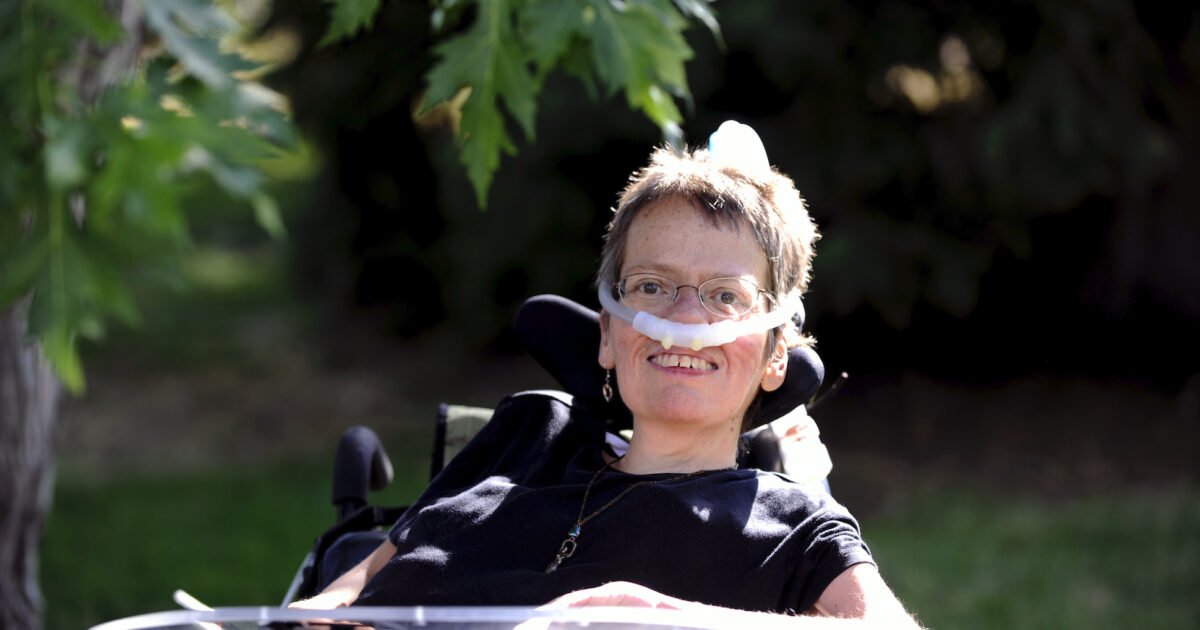
Laura Hershey Poetry Lesson: “You Get Proud By Practicing”
Students will analyze Laura Hershey’s poem, “You Get Proud By Practicing.” A poet, author, and activist, Laura Hershey first published the poem in 1991. To better understand its context, students will learn about neuromuscular diseases, disability activism in the 1980s, and the passing of the Americans with Disabilities Act of 1990 (ADA). Students will then analyze the poem for repetition and figurative language and understand what Hershey suggests it means to get proud. After discussing the poem, students will write and share their own poems about getting proud using those literary devices.
Image description: photo of Laura Hershey

More Than A Wheelchair: Accessibility Symbols
Students will consider the icon of the person in a wheelchair, the “International Symbol of Access.” They will learn about its history and the recent Accessibility Icon project that updated it. They will also consider other disability symbols, both in the US and internationally (such as symbols that indicate Deafness, Hidden Disabilities, and Autism, and how they are used/not used in other countries).
Art extensions include photography assignments to document iconography in their school and in everyday life and new symbol-making where students make new symbols that could replace the wheelchair, and be more inclusive.
Geography extension is a study of symbols and use/news about them in other countries. Students will be assigned a country to study either individually or in groups, and explore disability iconography in that place. This activity would work well as a library-based extension as well.
Image Description: a white and blue reserved parking sign with a traditional wheelchair accessible symbol and a clear backed sticker of the new Accessible Icon in red pasted over it.

New York Times: Learning With: ‘Adaptive Video Game Controllers Open Worlds for Gamers With Disabilities’
This lesson explores how adaptive video game controllers are transforming gaming for players with disabilities. Students will first reflect on their own gaming experiences before analyzing a commercial and reading an article about accessibility in gaming. Through discussion questions, they will examine the challenges faced by disabled gamers, how technology has evolved to be more inclusive, and the broader impact of adaptive controllers. The lesson encourages critical thinking about accessibility in technology and invites students to consider how they would design more inclusive gaming experiences.
Image Description: "The Learning Network Teaching & Learning with the New York Times" Below the text is a photo of Erin Hawley playing video games with her family. She uses an adaptive controller.

One Out of Five lesson series
The purpose of this lesson is to humanize the experience of disability by focusing on student-voice videos, recognize diversity within the disability community, and discuss ways to promote accessibility. This is the first in a series of 5 lessons by Washington State’s One Out of Five Disability History and Pride Project.
Image Description: Groups of students sit and stand, talking in clusters. The profiles of the students of different ages, races, and abilities is on a colorful background of yellow, orange, and green. The dominant image is the silhouette of a male student in dark blue reading a book. The title is: One Out of Five: Disability History and Pride Project. “One” and “five” are spelled out in American Sign Language. At the bottom, Braille reads: “pride” and “history.”]
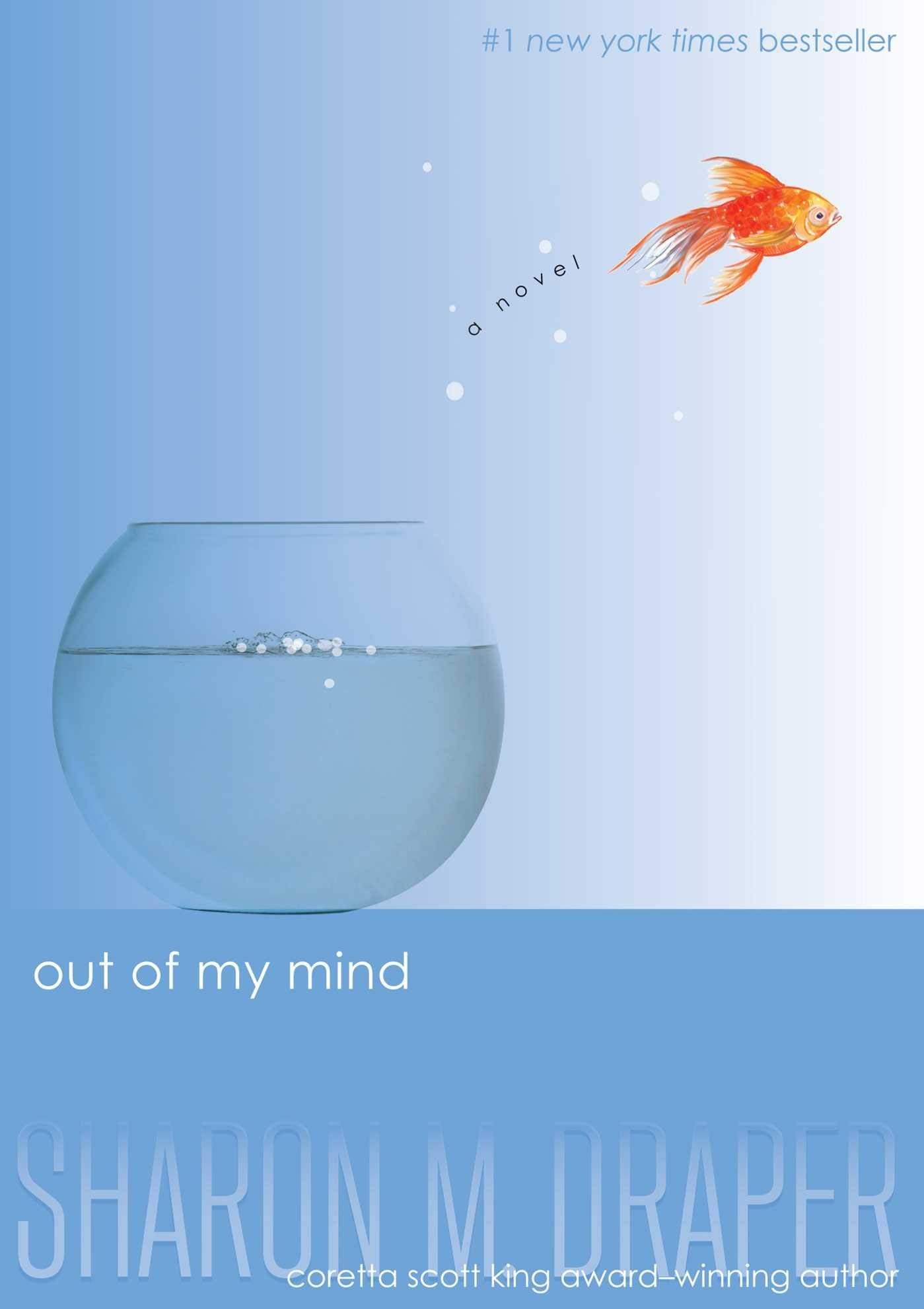
Out of my Mind - Book Discussion Guide
Out of My Mind is narrated by a girl with cerebral palsy who's very intelligent but unable to express herself by speaking or physically. When Melody is integrated into some general classes at school, many kids are purposely mean; others, including teachers, are cruel through their assumptions that Melody is incapable of understanding them. With the help of her parents and some supportive friends and teachers, Melody acquires a machine that allows her to communicate better than she ever has before (Common Sense Media). At last Melody has a voice… but not everyone around her is ready to hear it (Draper, 2010). This book discussion guide can also be adapted into a full assignment if that is more applicable for your student group.
Image description: Cover from the book “Out of My Mind”
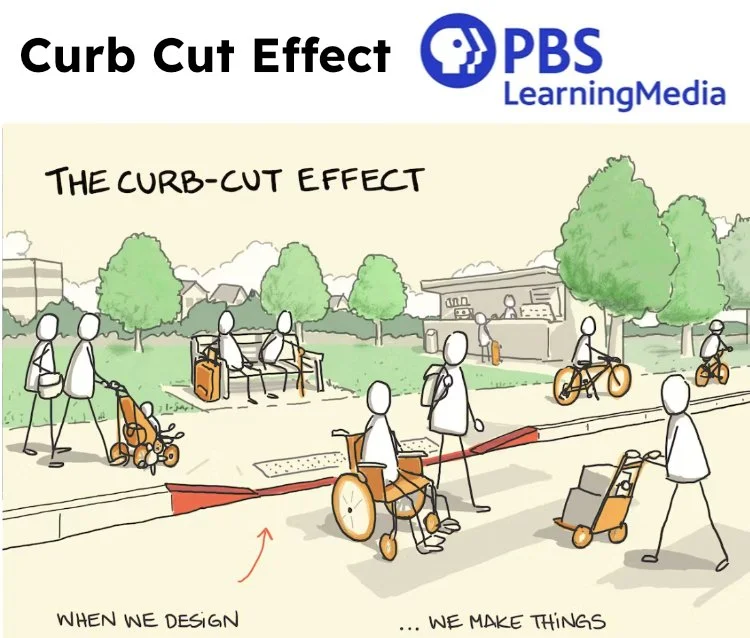
PBS Learning Media - The Americans with Disabilities Act (ADA) and the Curb-Cut Effect | Interactive Lesson
Students explore the history of curb cuts, from early disability rights advocacy in the 1940s through the passage of the Americans with Disabilities Act in 1990, and examine how accessibility features designed for disabled people often benefit far broader communities. Through an interactive lesson and writing prompt, students consider how civic engagement by a specific group can shape policy in ways that serve everyone.
Image Description: “Curb Cut Effect” in black text “PBS Learning Media” in blue text with the PBS logo. Below the text is an illustration using stick figures in a street scene showing a curb cut and a variety of wheelchairs and other wheeled things with the people using them
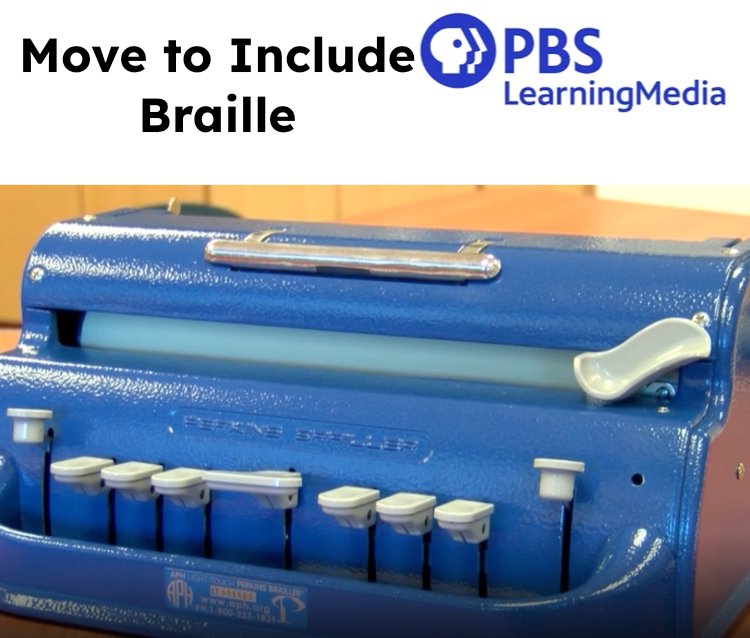
PBS Learning Media - Braille | Move to Include
Students watch a short video introducing Braille as a tactile literacy system and learn how it works as a code of raised dots representing letters and words. Through background reading and discussion questions, students explore how Braille functions as a tool for access and consider how technology has expanded the ways blind, low-vision, and deaf-blind people interact with written language.
Image Description: “Move to Include” in black text “PBS Learning Media” in blue text with the PBS logo. Below the text is a blue brailler.
Peter and Wendy by J. M. Barrie: Disability Informed Reading Guide
Peter and Wendy by J. M. Barrie: Disability Informed Reading Guide
Image Description: “Peter and Wendy by J. M. Barrie: Disability Informed Reading Guide” pale green background with black text. Simple black book with white pages graphic.

Portrait of the Whole Person - Disability Rights Washington
Portrait of the Whole Person is a curriculum for elementary school students designed to teach students how disability rights fit into the broader civil rights movement, to perceive disability as a reflection of societal views of differences, and to treat people with disabilities with respect and dignity. It contains four distinct lesson plans comprised of three in-class instruction lesson plans and one lesson plan governing the research and writing of a biographical sketch and creation of a portrait of a notable person with a disability. It is also complete with a graphic organizer, rubrics, a power point, and a list of references students can use for research.
Image Description: Disability Rights Washington logo with “Portrait of a Whole Person Curriculum Overview” written below and drawings of 3 different people in colored pencil.
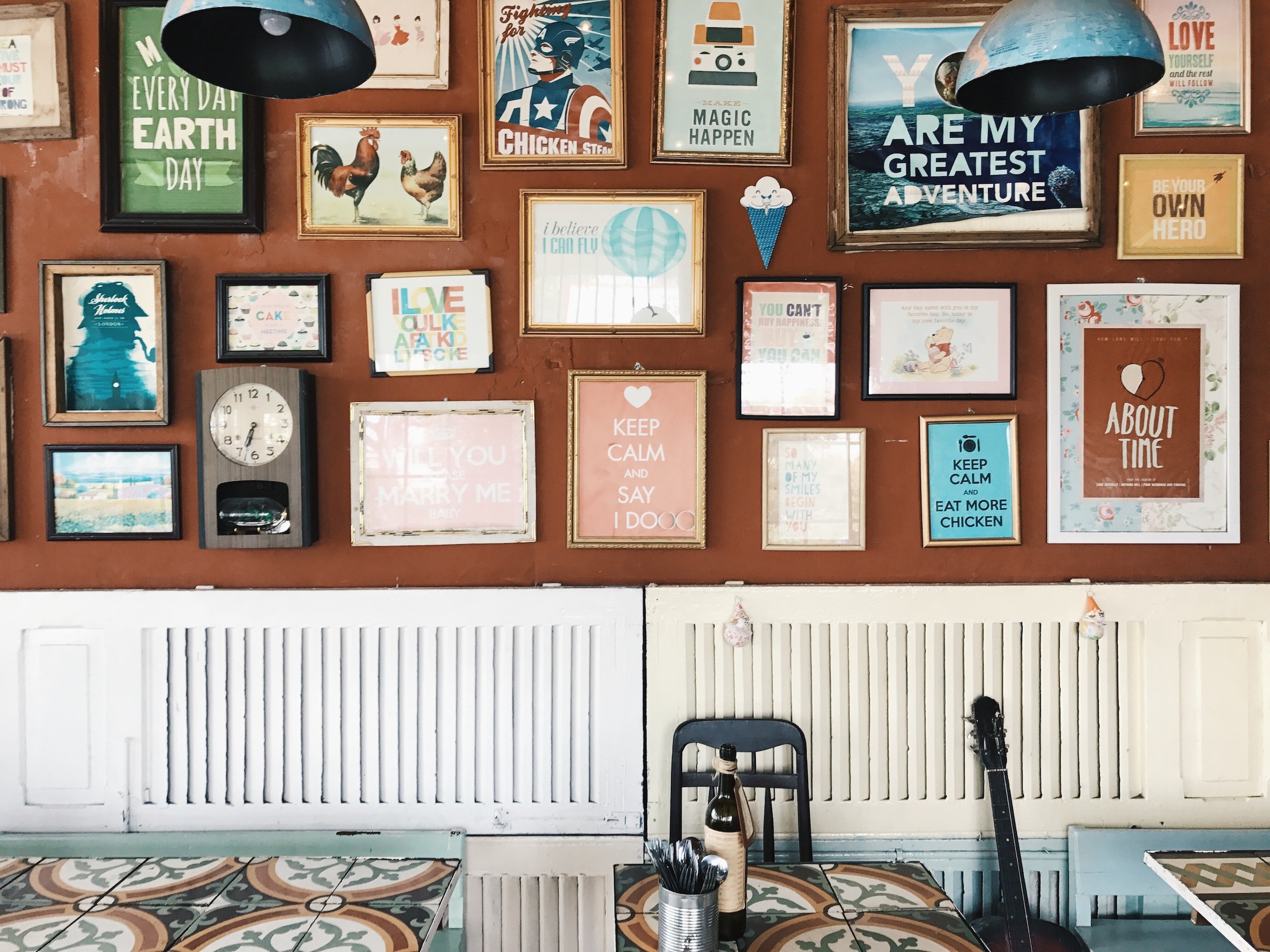
Posters with Disability Inclusive Content
Posters with disability representation. Most are free to download, though some can be purchased as well.
Image description: Corkboard wall with many signs of assorted size and colors.

Simple Things Count: How can I help?
This two-session lesson engages students in exploring ways to be more inclusive of people with disabilities. Through a series of short, accessible disability voice videos, students will recognize diversity within the disability community and learn practical steps to foster inclusion. Using discussion, reflection, and interactive activities, students will examine their own discomfort, identify attitudinal barriers, and explore how small actions can create more accessible and welcoming environments.
This lesson provides a foundation for students to understand the impact of their actions and equips them with strategies to promote disability inclusion in everyday life.
Image Description: Screenshot of video titled “Simple Things Count” text also includes “Emily Ladau - Disability Rights Activist” with an illustration of Emily seated in her wheelchair
The Social Model of Disability
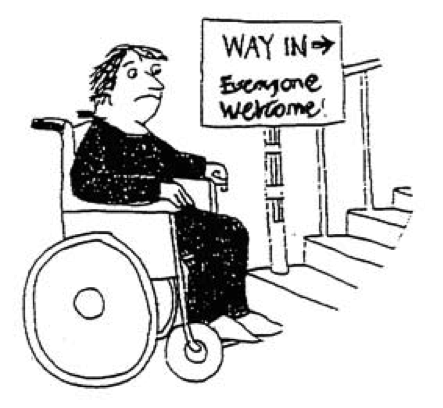
This links to our Social Model of Disability resources page which contains videos and examples of how to introduce and teach the Social Model of Disability.
Image description: Illustration of a person seated in a wheelchair at the bottom of a set of stairs. There is a sign at the bottom of the stairs pointing to the stairs that says “WAY IN Everyone Welcome!”
Social Model and Accessibility Proposal
In this lesson students will survey their school environment, learn from a person(s) with a disability and research accessibility in schools. Students will have a chance to ask the speaker(s) questions and have a discussion with speaker(s) about the Social Model of Disability. They will use the information collected to design a brand-new school building with full accessibility for people with disabilities.
Image description: Illustration of a person seated in a wheelchair at the bottom of a set of stairs. There is a sign at the bottom of the stairs pointing to the stairs that says “WAY IN Everyone Welcome!”