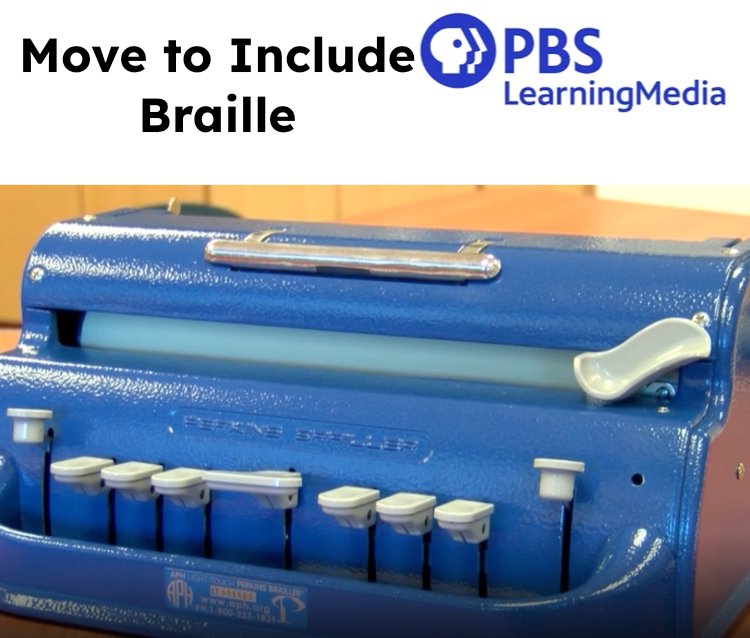
PBS Learning Media - Braille | Move to Include
Students watch a short video introducing Braille as a tactile literacy system and learn how it works as a code of raised dots representing letters and words. Through background reading and discussion questions, students explore how Braille functions as a tool for access and consider how technology has expanded the ways blind, low-vision, and deaf-blind people interact with written language.
Image Description: “Move to Include” in black text “PBS Learning Media” in blue text with the PBS logo. Below the text is a blue brailler.

PBS Learning Media - Renegades Lessons
Summary:
Renegades is a documentary series from American Masters that showcases the lives and cultural contributions of little-known historical figures with disabilities. These lessons were designed to be used with the videos. They can be used individually or as a unit.
Image Description: “Renegades” in black text “PBS Learning Media” in blue text with the PBS logo. below the text are a series of 5 colorful images from each of the 5 short films. Left to right, Brad Lomax, Celestine Tate Harrington, Daniel K. Inouye, Judy-Lynn Del Ray, and Thomas Wiggins

Personify a Word with Social Media Lesson
Students will research concepts related to disability and then create a physical Pinterest board in groups. Each group will present and discuss their concept in a gallery walk style. This lesson highlights the social model of disability as well as introducing disability topics.
Image description: the word “personification” repeated over and over at an angle

Posters with Disability Inclusive Content
Posters with disability representation. Most are free to download, though some can be purchased as well.
Image description: Corkboard wall with many signs of assorted size and colors.

Richard III: Disability Informed Reading Guide
Richard III: Disability Informed Reading Guide
Image Description: “Richard III: Disability Informed Reading Guide” pale green background with black text. Simple black book with white pages graphic.
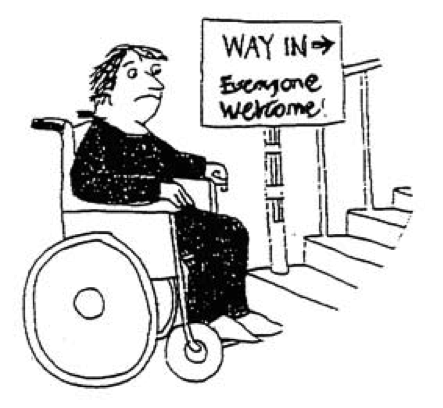
The Social Model of Disability
This links to our Social Model of Disability resources page which contains videos and examples of how to introduce and teach the Social Model of Disability.
Image description: Illustration of a person seated in a wheelchair at the bottom of a set of stairs. There is a sign at the bottom of the stairs pointing to the stairs that says “WAY IN Everyone Welcome!”

Statistics and Disability Representation
This lesson integrates statistics with disability acceptance to enhance both mathematical understanding and social awareness. Over the course of three class periods, students analyze statistical data related to disabilities such as employment rates, educational attainment, and media representation. Students will then create various types of graphs, and discuss the representation and treatment of people with disabilities in society.
The lesson includes a mix of video content, group discussions, data analysis, and presentations, culminating in a reflection activity to deepen students' empathy and awareness. By engaging with real-world data, students develop their skills in calculating mean, median, mode, and range, while also promoting inclusivity and acceptance.
Image Description: Person in wheelchair pointing to a stylized web browser with various graphs and charts on it. The accessibility icon is in the bottom left-hand corner.

Thinking Critically about Disability - Social Media Lesson
When Stephen Hawking passed away, many artists processed the loss through art. Their art depicts disability from multiple perspectives. In this activity students will explore 2 contrasting images. Take note of the details and how the images depict Stephen Hawking and his physical disability. Both of the images are from Twitter and students may have already seen both of the images just scrolling through their phones. Students will explore elements of art, social studies and psychology in this lesson. The focus of the discussion is up to individual educators.
Image description: illustration of Stephen Hawking, seated in his motorized wheelchair, floating above the earth with other planets in the background

We Will Ride Lesson by Pop Culture Classroom
In this lesson students will read a 2-page graphic novel format story about the Gang of 19 and “We Will Ride” action, and how they fought for equal rights for the disabled.
Image Description: Graphic Novel cover showing protesters in purple black and off white on a green background with the title “Colorful History Comics #31 We Will Ride” underneath the comic.